
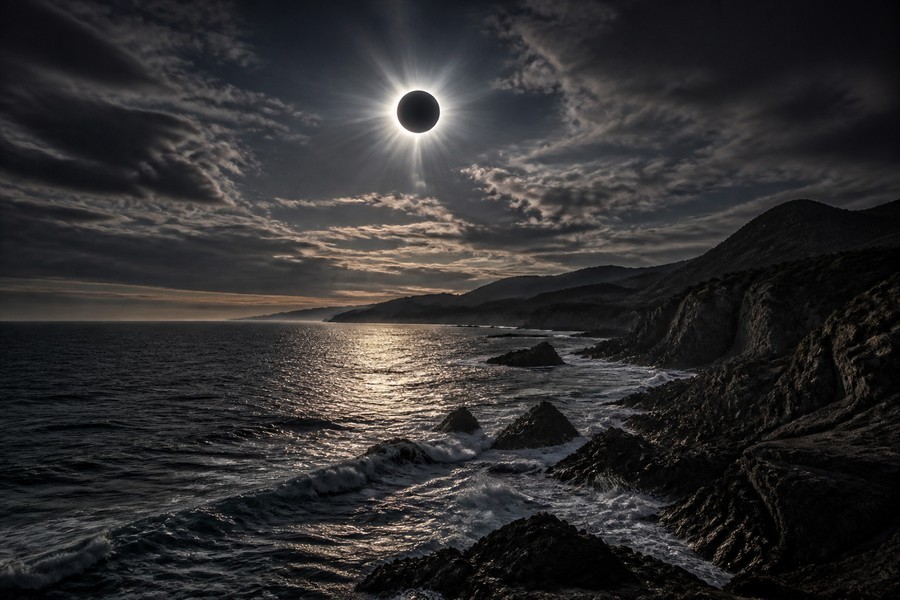
Preparing for the Spectacular Darkness of the Next Total Solar Eclipse
An exciting astronomical event is drawing near as a total solar eclipse prepares to journey across the sky. This event will mark the first time in over two decades that parts of Europe will experience a total solar eclipse. The path of complete darkness will travel across Greenland, Iceland, northern Spain, and the Balearic Islands. Meanwhile, millions of other skywatchers in parts of northeastern North America and western Europe will be treated to a partial eclipse, where the moon appears to take a bite out of the sun.
Understanding the Stages of a Total Eclipse
During a total solar eclipse, the moon passes directly between the Earth and the sun, completely blocking the sunlight. This brief period of total darkness is known as totality. During these few minutes, daytime turns into a deep twilight, temperatures drop, and the sun's outer atmosphere, called the corona, becomes visible to the naked eye.
The event unfolds in several distinct stages:
- First Contact: The moon first starts to cover the edge of the sun, creating a partial eclipse.
- The Diamond Ring Effect: Just before the sun is completely covered, a single bright point of light shines out, looking like a giant diamond ring in the sky.
- Totality: The moon fully covers the sun, revealing the glowing corona. This is the only time it is safe to look directly at the eclipse without eye protection.
- Third and Fourth Contact: The moon begins to move away, the diamond ring effect appears on the opposite side, and the sun slowly returns to normal.
Observing from Icy Fjords and Warm Plains
Observers are positioning themselves in different parts of the world to capture this rare sight. One viewing effort is taking place from a ship sailing along the remote, icy coast of East Greenland. The goal is to view the eclipse from the middle of a massive fjord system. While the current weather forecasts for the region show a high chance of clouds, the travelers remain hopeful and are ready to adjust their route to find clear skies.
Farther south, another group of observers is gathering in a small town in northern Spain. In this location, the eclipse will occur very late in the day. Spectators there will see the blocked sun hanging low on the western horizon, just before sunset. This will provide a unique photo opportunity as the darkened sun sinks toward the earth.
Volunteers Helping with Space Science
The upcoming eclipse is not just a treat for tourists; it is also a major opportunity for scientific research. A network of volunteer citizen scientists is preparing to collect valuable data during the event. Led by professional astronomers, these volunteers will set up cameras and telescopes along the path of totality.
Their goal is to capture high-quality images of the sun's outer atmosphere. Because the moon blocks the bright glare of the sun, eclipses offer a rare chance to study the corona from the ground. The data collected by these volunteers will help scientists better understand solar winds and space weather.
Could the Northern Lights Make an Appearance?
For those watching from northern regions like Greenland and Iceland, an interesting question has come up: Is it possible to see the northern lights during the eclipse? Because totality brings a sudden darkness similar to twilight, the sky might get dark enough for auroras to become visible.
While this would require a highly active solar storm to occur at the exact same time as the eclipse, it is not completely impossible. If the timing is just right, observers in the far north could witness a truly rare double feature of nature.
How to Prepare for the Big Event
Whether you are traveling to the path of totality or watching a partial eclipse from your backyard, preparation is key to having a safe and enjoyable experience. Here are a few important steps to take before the eclipse begins:
- Get certified safety glasses: Looking directly at the sun is highly dangerous. Make sure you have eclipse glasses that meet the official ISO 12312-2 safety standard. Do not use regular sunglasses or damaged eclipse glasses.
- Try alternative viewing methods: If you do not have glasses, you can make a simple pinhole projector using cardboard to project the sun's image onto the ground.
- Charge your devices: Make sure your cameras, phones, and backup batteries are fully charged well ahead of time.
- Check the local weather: Keep an eye on the forecast. Even if there are thin clouds, you can still experience the sudden drop in temperature and the dramatic darkness of totality.
- Plan your timing: Know exactly when the eclipse starts and ends in your specific location, and arrive at your viewing spot early to avoid traffic.
Will Clouds Ruin the Show?
One of the biggest worries before any eclipse is the weather. While a perfectly clear sky is the best-case scenario, you do not necessarily need perfect weather to enjoy the experience. Even under thin clouds, many of the most dramatic effects of totality, such as the sudden darkness and the drop in temperature, can still be felt and observed.