
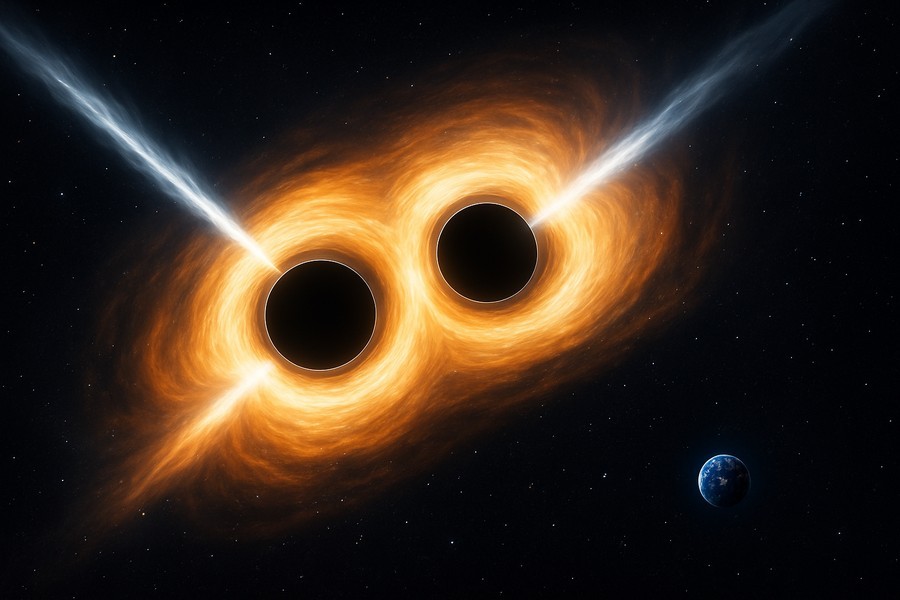
Giant Black Holes on a Collision Course Might Impact Earth
A pair of enormous black holes, spouting intense light, are apparently on a collision course. If this collision occurs, even though it's predicted to happen a century from now, the effects might be felt right here on Earth.
These fascinating findings were made thanks to long-term study and observations done using radio telescopes. The attention of astronomers was drawn to a tremendously bright object, believed to be a blazar, which is the glowing core of a galaxy. This blazar was thought to be powered by a black hole and is located about 500 million light-years away from our solar system. However, new discoveries point to a different reality.
A Hidden Energy Jet Reveals a Double Black Hole
After analyzing the observations, researchers found an unexpected energy jet. This discovery suggests that the intensely bright object is, in fact, not just one but two black holes on the brink of a collision. This event could take place even less than 100 years from now.
When the collision happens, based on the research, the outcome will likely be a single, merged black hole. The anticipation is high among the astronomers to witness this cosmic "dance" unfold.
Unraveling the Mystery of Blazars
Blazars are among the brightest objects in the universe and are classified as active galactic nuclei. These are objects at the center of galaxies that are actively feeding, typically powered by supermassive black holes. These black holes usually emit jets of high-energy radiation towards Earth.
In the case of the blazar being studied, something was unusual. The orientations of the jet observed over the years using radio telescope data were different, making it challenging to ascertain if its core truly did consist of a supermassive black hole.
Discovering a Second Jet
To solve this puzzle, researchers studied more than 83 datasets from an international network of 10 radio telescopes. The analysis revealed that there was not just one large jet, but also a second one looping counterclockwise around the blazar's center. The team believes that each of these jets is powered by a supermassive black hole, each having a mass that's between 100 million and a billion times that of the sun.
The moment of realizing the existence of the second jet was an amazing one. It was a breakthrough discovery that the researchers were excited to share.
A Pair of Supermassive Black Holes
A significant finding came when the two black holes aligned perfectly. The gravity of the primary black hole bent the light emitted by the second jet into a near-complete circle, known as an Einstein ring. This discovery, made possible by gravitational lensing, reinforces the theory that the blazar is powered not by one but two supermassive black holes.
The two black holes are believed to circle each other clockwise approximately once every 121 days. They are only separated by 250 to 540 times the distance between Earth and the sun, which is considered relatively close in astronomical terms. Over time, this distance will decrease until the two celestial bodies eventually merge.
The Aftermath of the Collision
The researchers speculate that when the inevitable collision of the two black holes happens, they will emit gravitational waves. These are ripples in the fabric of space-time produced by the most powerful events in the universe. These waves could be stronger than those from previously observed black hole mergers. If that happens, gravitational wave detectors on Earth will be able to detect the signal, providing new insights into the properties of the original pair of black holes.