
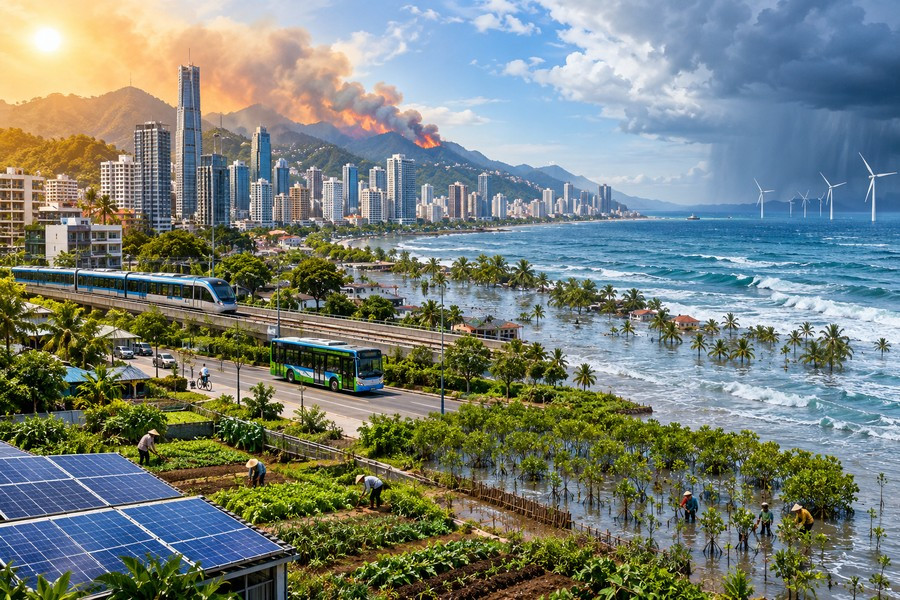
Asia Faces Climate Tipping Points, but Fast Change Could Still Help
Deadly heat waves are filling cities with emergency calls. Wildfires are spreading across borders and sending dangerous smoke into the air. Changing ocean currents are threatening crops and raising the risk of floods in coastal communities.
These events show how human-caused climate change is pushing Earth’s natural systems toward climate tipping points. Beyond these limits, some changes could speed up on their own and become very difficult, or even impossible, to reverse.
A Region at the Center of the Crisis
Asia is especially important in the climate fight because it is home to about 60% of the world’s people. A major international meeting in Malaysia brought together more than 500 experts and other participants from Asia and Europe to discuss how the region can avoid the worst effects of climate change.
The meeting was the third event in a conference series about climate tipping points and the first one held in Asia. Its main question was clear: how close is the world to dangerous climate limits, and what can Asian countries do to prevent further damage?
Global warming is now expected to move beyond the 1.5-degree Celsius limit set by the Paris climate agreement. That makes it more likely that several natural systems will reach points where damage grows quickly.
Coral Reefs Are Already in Danger
Warm-water coral reefs are among the clearest examples. Their heat limit has already been passed after about 1.2 degrees Celsius of warming. Coral reefs around the world are dying at a record pace and across larger areas than ever before.
Nearly all coral reefs could disappear by 2075. This would harm more than ocean scenery. Reefs provide shelter and food for more than one million marine species. They also support fishing, tourism, and the income of many coastal communities.
Other systems are showing serious warning signs as well:
- Parts of major polar ice sheets may have passed important danger points.
- Some mountain glaciers are also at risk of continuing, self-reinforcing loss.
- A powerful Atlantic ocean current may be weakening toward a possible collapse.
This Atlantic current carries heat and nutrients northward. If it weakens sharply, winters in northwestern Europe could become colder, while heat waves in the Southern Hemisphere could last longer.
The Need for a Faster Response
One climate scientist who helped lead the meeting said the world will likely exceed the 1.5-degree goal. The remaining path, he explained, is to limit the overshoot, reach a peak in warming, and then bring temperatures back down.
That task will require much more than small, gradual improvements. Countries will need large and rapid changes in energy, transportation, farming, finance, law, health care, and community planning. The goal is to protect prosperity while also improving fairness and resilience.
The climate emergency was visible during the meeting itself. Many people wore masks and complained of sore throats because of toxic haze spreading across national borders. The haze came from land clearing and fires in peatlands in Indonesia. Hotter and drier conditions linked to climate change made the problem worse.
Positive Tipping Points Are Possible
Participants also pointed to encouraging changes. Some technologies and social movements are spreading so quickly that they can push entire markets away from fossil fuels.
Electric vehicles provide one example. In Norway, electric vehicles now make up almost all new car sales. Strong public policies and organized campaigning helped make the shift possible. A small group of committed people, working with a clear plan, helped influence an entire national market.
Solar power is growing quickly in Pakistan as well. Falling panel prices have allowed people without reliable access to electricity to install solar systems in homes, small communities, and off-grid areas. Solar panels have become so popular that some families now include them as part of wedding dowries.
Pakistan added 27 gigawatts of small-scale solar power in only two years. That amount equals the total capacity of all the country’s coal, gas, and oil power plants built throughout its history. Solar panel imports also rose from less than 1 gigawatt to more than 51 gigawatts. During the same period, oil and gas imports fell by 40%.
Building Support Across Society
The meeting focused on more than energy. Participants discussed ways to use laws, financial systems, medical services, and religious communities to speed up environmental progress.
A 260-page guide for faith leaders was introduced during the gathering. It explains how religious teaching can include the health of the planet. This approach could reach a large audience because more than three-quarters of the world’s population identifies with a religion.
The meeting’s organizers said the goal was to bring climate tipping-point research to Asian communities and give people in the region a stronger voice in describing local solutions. They also stressed that governments, businesses, scientists, health workers, community leaders, and religious groups must work together.
The warning is urgent, but the future is not fixed. Dangerous climate thresholds are getting closer, yet positive changes are also spreading. Rapid action could help expand clean energy, protect ecosystems, reduce pollution, and give communities a better chance of avoiding the most damaging outcomes.