
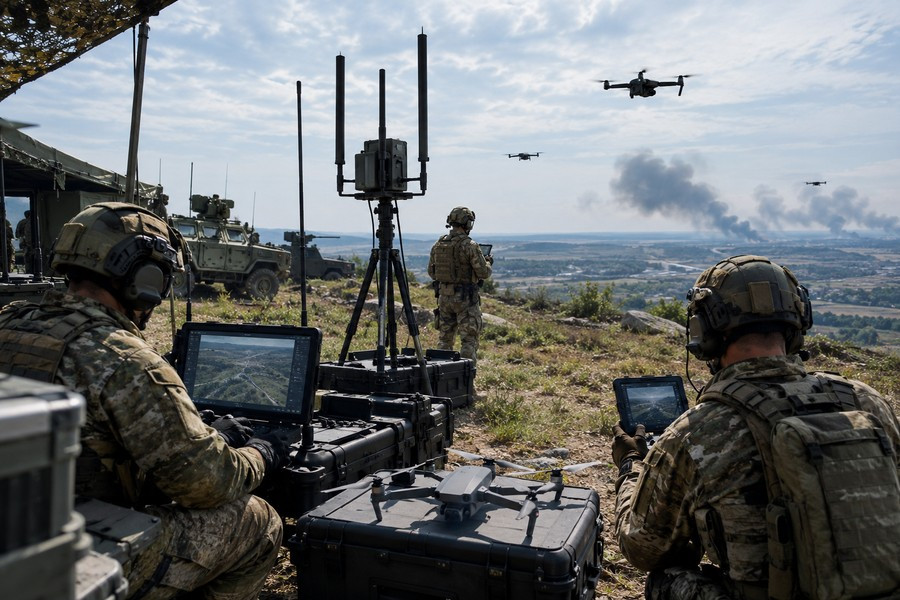
Drone Warfare Is Reshaping the Battlefield, Former Army General Warns
Unmanned weapons have changed the fighting in Ukraine, where drones now cause more than 90% of Russian casualties on the front lines, retired Army General David Petraeus said. He warned that military forces must make major changes to prepare for battles shaped by drones and other autonomous systems.
Drones Are Used by the Thousands
Petraeus said Ukraine and Russia each use about 10,000 drones a day. The scale of their use shows how much modern warfare has changed, he said. In his view, tanks are no longer safe enough for many front-line missions.
Ukraine has relied on drones and other unmanned weapons to help its smaller military fight a larger and better-funded opponent. The country made unmanned warfare a formal part of its military by creating a dedicated branch for these forces in 2024. Its defense leaders have also made the development of autonomous weapons a top priority.
Petraeus said the fighting offers other countries a warning about what future wars may look like. He argued that NATO countries, including the United States, have not yet made the deep changes needed to respond.
A Wider Military Overhaul
Preparing for drone warfare would require more than adding new weapons, Petraeus said. The United States would need to rethink how it organizes its forces, trains troops, buys equipment, manages military careers, and builds bases.
He called for replacing some older equipment that requires large crews with unmanned systems that cost less and can be produced in greater numbers. He also expects autonomous systems to play a larger role in combat than they have in the past.
The United States has taken some steps toward developing these weapons. A new command focused on autonomous warfare is being set up, and each military branch is expected to create a related command of its own. Petraeus said those changes could help, but he wants them to lead to a broader shift in how the military operates.
Factories Must Keep Up With Change
Petraeus said the country needs strong manufacturing capacity for unmanned systems, even if factories do not run at full speed all the time. The ability to change designs quickly matters because weapons and defenses keep evolving during a war.
He pointed to Ukraine’s experience, where software updates can be made every week and hardware can be changed every few weeks. Russia has also been improving its systems, he said, so Ukraine must keep adapting.
Ukraine plans to produce as many as 20 million unmanned systems in a year, President Volodymyr Zelenskyy said in a speech. But the country faces limits on how quickly it can build them. It needs more trained operators and enough parts to keep production moving.
- Optics used to guide or observe targets
- Gimbals that help keep equipment steady
- Brushless motors that power drones
- Fiber-optic cable used in some unmanned systems
Support for Ukraine Is a Policy Choice
Petraeus rejected the idea that the U.S. war with Iran prevents the United States from helping Ukraine. He said the U.S. could provide support if leaders chose to do so.
He did acknowledge that the conflict has used many missile interceptors. That leaves fewer available to share with other countries. An estimate by the Congressional Budget Office said the war had used between one-half and two-thirds of the U.S. supply of certain missile-defense interceptors.
Petraeus described the decision to help Ukraine as a matter of policy. His larger warning was that militaries must adapt to a battlefield where large numbers of low-cost, rapidly changing unmanned systems can shape the fight.