
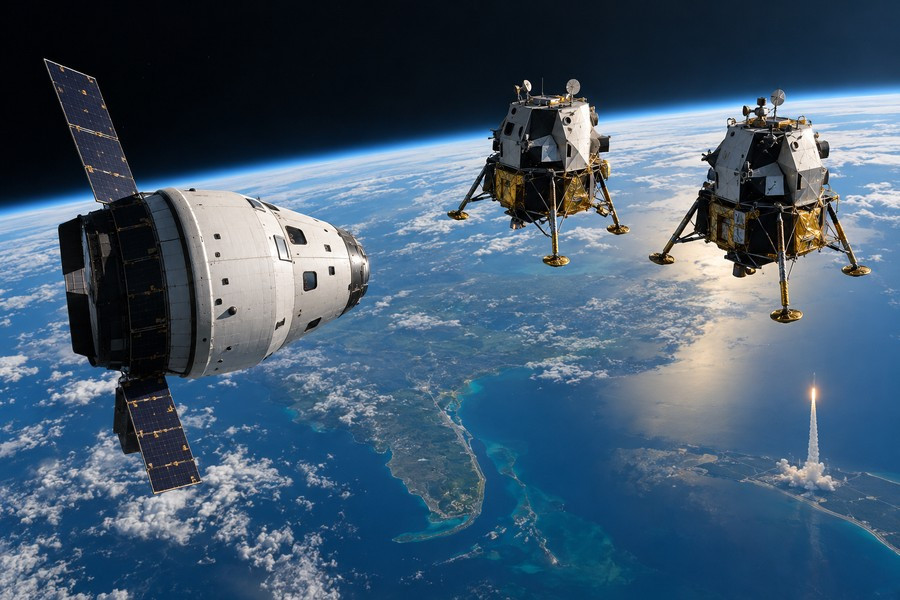
A Complex Moon Mission Takes Shape With Three Launches and Two Landers
A Major Test Before Future Moon Landings
A planned crewed space mission will serve as a major test for future trips to the moon. The flight will bring together three powerful rockets, two privately built lunar landers, and a crew capsule in one of the most difficult space operations ever attempted.
The mission is designed to test how astronauts, spacecraft, and ground teams work together in Earth orbit before NASA commits to a crewed landing near the moon’s south pole.
The four-person crew will include astronauts Randy Bresnik, Andre Douglas, Frank Rubio, and international astronaut Luca Parmitano. They will travel inside a crew capsule launched by a heavy-lift rocket from Florida’s Space Coast.
Three Rockets, One Mission
The mission will begin with the launch of a heavy rocket carrying a privately developed lunar lander into low Earth orbit. A second rocket will then send the crew capsule and its astronauts into space.
The crew capsule will first enter a stretched orbit. At its closest point, the capsule will pass about 18 miles above Earth. At its farthest point, it will reach about 1,122 miles above the planet.
The capsule will later move into a more stable orbit about 345 miles above Earth. This change is needed because the capsule was built for deep-space travel, where it faces different temperatures. Operating in low Earth orbit will create a tougher thermal environment that mission teams must carefully control.
A third rocket will launch a large upper-stage spacecraft equipped with a special docking device. That vehicle will later meet the crew capsule in orbit.
The Crew Will Test the First Lander
The astronauts are expected to spend about two days checking the crew capsule and its systems before meeting the first lunar lander. The rendezvous will take place about 273 miles above Earth.
After docking, the astronauts will enter the lander and inspect its main systems. Their work will include testing:
- Environmental controls
- Life-support equipment
- Cabin pressure and air systems
- Emergency procedures
- Control of both connected spacecraft
Ground teams will also practice handling problems that could happen while the two vehicles are joined together. These exercises are meant to show whether the lander can safely support astronauts and whether flight controllers can respond quickly during an emergency.
A Short Meeting With the Second Vehicle
After the first set of tests is finished, the second private spacecraft will launch. It will meet the crew capsule in low Earth orbit about two days later, at an altitude of roughly 237 miles.
This meeting will be much shorter than the operation with the first lander. The astronauts will not enter the second spacecraft. Instead, they will use the docking operation to gather important information about the forces created when the vehicles connect.
The test will also show how the spacecraft can work together while attached and how much pushing or pulling occurs during docking. That information will help engineers prepare for future missions in which the vehicle may carry astronauts toward the moon.
More Work Before the Crew Returns
After separating from the second spacecraft, the crew will remain in orbit for several more days. The full mission is expected to last about two weeks, though it could continue for several days longer if needed.
The astronauts will test survival suits that were not fully evaluated during an earlier crewed lunar flight. They will also complete health checks, science work, and technology demonstrations.
Once the mission is complete, the crew capsule will return to Earth. Parachutes will slow its descent before it splashes down in the ocean.
Preparing for the Next Lunar Landing
The main purpose of the mission is to lower the risks of future lunar landings. Teams will practice making fast decisions, solving problems, and coordinating several spacecraft in orbit.
Working near Earth gives astronauts a quicker way home if something goes wrong. The lessons learned during the mission could help prepare crews for a landing near the moon’s south pole.
NASA has not yet chosen which of the two private landers will carry astronauts to the lunar surface. Keeping both options open gives each company more time to prove that its vehicle is ready.
The two landers would use different mission plans. With one design, the crew capsule would meet the lander after reaching lunar orbit. With the other, the large spacecraft could connect with the capsule while still near Earth and then help push the combined vehicles toward the moon.
Schedule Problems Remain
The exact launch date has not been set. The mission is facing schedule pressure, and internal planning has shown that work is running about 90 days behind the expected timeline.
One of the biggest concerns involves obtaining the parts and equipment needed for the lunar landers. Even with those problems, NASA leaders say the teams are working quickly to resolve delays and keep the mission moving.
Both private companies are also planning their own lunar landing missions. The results of those efforts will help determine which spacecraft is ready to carry astronauts on the next major journey to the moon.