
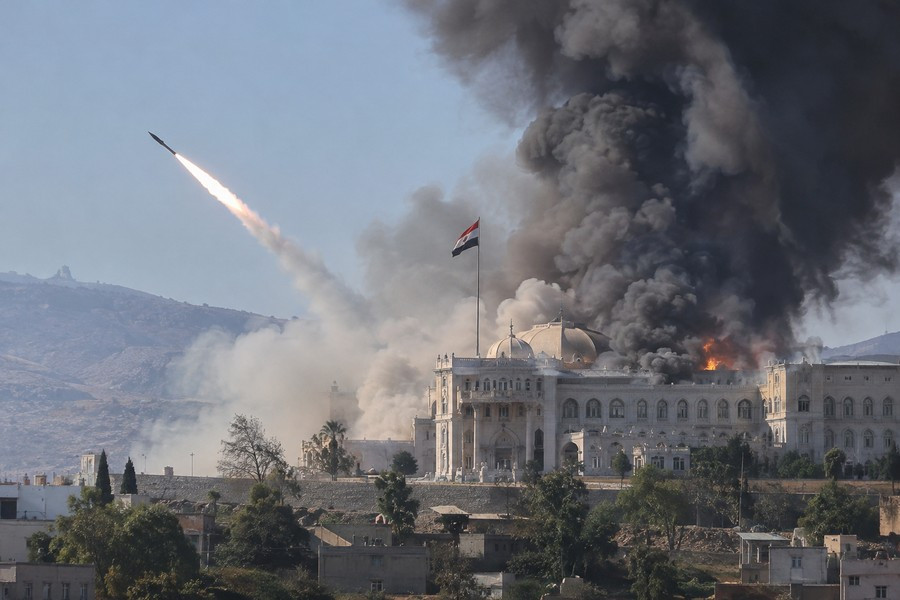
Missile Strike on Yemen’s Presidential Palace Kills Five
A missile attack hit the presidential palace in Aden, a port city in southern Yemen, killing five people and injuring 16. The palace, known as al-Maashiq, serves as the headquarters of Yemen’s internationally recognized government.
Five ballistic missiles struck the site. Yemen’s prime minister and other government ministers were not hurt.
Government Says It Will Continue Fighting
Prime Minister Shaya Zindani condemned the strike, describing it as cowardly and part of the Houthis’ ongoing violence. He said the government would continue its work and that the attack would not weaken its forces’ determination.
Government troops are carrying out operations against the Houthis along Yemen’s southwestern Red Sea coast and on other battle lines. The Houthis are an armed group backed by Iran. A coalition led by Saudi Arabia supports Yemen’s government and provides air support to pro-government forces.
Missile and Drone Attacks Across the Region
The strike in Aden came amid growing attacks between the Houthis and Saudi Arabia. The Houthis have launched missiles and drones at Saudi airports, oil and gas sites, military bases, and ships. They say these attacks are retaliation for air strikes on areas they control in western Yemen, including the capital, Sanaa.
Saudi Arabia’s coalition said it had intercepted a cruise missile in the Medina region, where one of Islam’s holiest sites is located. The Houthis denied carrying out an attack on Saudi Arabia in that incident.
A separate missile strike on Riyadh’s international airport killed 13 people. It was the deadliest attack in Saudi Arabia in more than a decade.
Dispute Over Iran’s Role
Saudi Arabia has accused Iran of arming, training, and supporting the Houthis in violation of United Nations Security Council resolutions. A Saudi official said Iran was encouraging the group’s recent escalation.
Iran’s government did not immediately respond to the accusation. Iran has previously denied sending weapons to the Houthis, while saying that its support for them is political. Iran’s foreign minister has also offered help to start talks between Saudi Arabia and the Houthis.
A Long and Worsening Conflict
Yemen’s civil war began in 2014, when the Houthis took control of Sanaa and pushed the internationally recognized government out of the capital. The fighting grew more intense in 2015, after a Saudi-led coalition of Arab states entered the conflict to try to restore the government’s rule.
An informal ceasefire had lasted for four years, but it began to break down in July. The Houthis announced what they called a “maritime embargo” against Saudi Arabia and began attacking Saudi airports, oil facilities, and tankers in the Red Sea with missiles and drones.
The group said its actions were a response to what it calls a Saudi blockade of Houthi-controlled areas and an air strike on Sanaa’s airport. The Houthis blamed Saudi Arabia for that strike.
Fighting Near a Key Shipping Route
The conflict intensified again in September, when Houthi forces captured part of Yemen’s southwestern Red Sea coast near the Bab al-Mandab Strait. The narrow passage is a major route for global shipping.
The Houthi advance helped push oil prices higher. The increase came after six months of war involving the United States, Israel, and Iran.
Pro-government forces later said they had retaken land overlooking the strait. They launched a major counterattack with support from Saudi air strikes. Control of the area remains important because of its position near one of the world’s busiest shipping routes.