
Iraq’s Parliament Completes Key Cabinet Appointments as Economic Pressure Grows
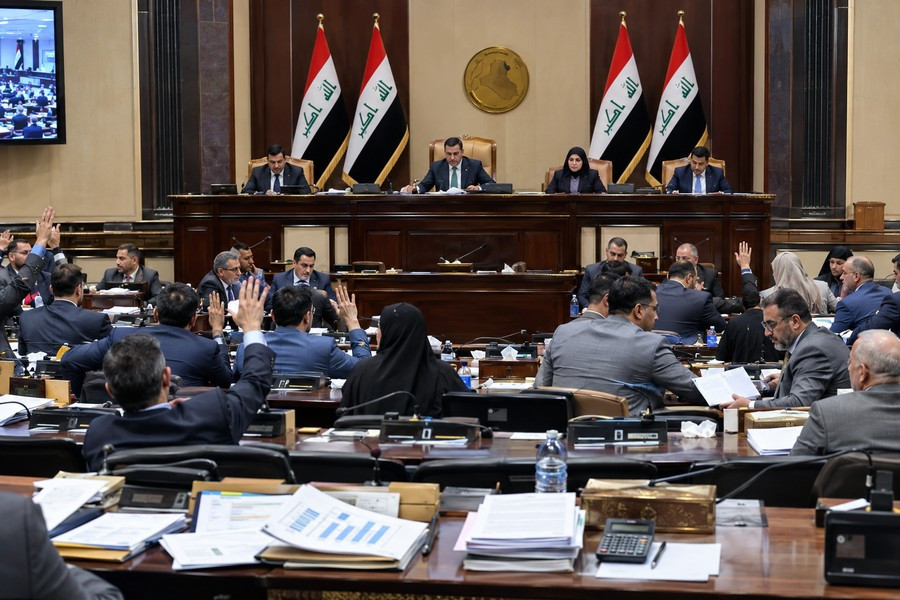
Iraq’s parliament has approved the remaining members of Prime Minister Ali al-Zaidi’s government, filling several important cabinet positions and naming three deputy prime ministers. The vote completes most of the government’s formation while the country faces serious financial and security problems.
Lawmakers Fill Major Government Posts
Parliament approved 11 cabinet positions. The new ministers include Nayef al-Shammari, who will lead the Defense Ministry, and Yasir al-Maliki, who will head the Interior Ministry.
Lawmakers also approved ministers for planning, culture, and higher education and scientific research. These ministries play a major role in managing public services, education, national development, and government spending.
A vote on the nominee for migration and displacement minister was delayed. Political parties could not agree on who should take the job, leaving that position open for now.
The parliament also approved three deputy prime ministers. One of them is Laith al-Khazali, a senior member of the Iran-backed Asaib Ahl al-Haq movement. He is also the brother of the group’s leader, Qais al-Khazali.
Deputy Prime Minister Faces U.S. Sanctions
Laith al-Khazali’s appointment has drawn attention because both brothers face U.S. sanctions. The United States has labeled Asaib Ahl al-Haq a foreign terrorist organization.
U.S. officials have accused the group of carrying out attacks, including an assault that killed five American soldiers. The two brothers were also sanctioned over the deaths of protesters in Iraq.
The group has long been linked to Iran and remains part of Iraq’s powerful network of armed political movements. Its presence in the government highlights the difficult balance Iraq must maintain between political parties, armed groups, and foreign powers.
Prime Minister Calls for Fast Action
After the vote, al-Zaidi thanked parliament and called on the new ministers and deputy prime ministers to serve with commitment, skill, and honesty.
He said the government must begin working quickly to deal with what he described as exceptional economic and security challenges. The problems have grown during the ongoing war involving the United States, Israel, and Iran.
Al-Zaidi said the conflict has placed heavy pressure on Iraq’s economy. The country depends greatly on oil exports, and any disruption to shipping or energy markets can quickly reduce government income.
Oil Revenue at Risk
Before the conflict, Iraq exported about 3.5 million barrels of oil each day through the Strait of Hormuz. Oil provides about 90 percent of the government’s revenue.
Because of the fighting and the danger to regional trade routes, Iraq is facing a severe shortage of cash. The government must still pay public workers, support basic services, and meet other urgent obligations.
To help cover those costs, al-Zaidi approved a nearly 15 percent devaluation of the Iraqi dinar against the U.S. dollar. A weaker currency can raise the cost of imported goods and put more pressure on families and businesses, but the government says the move is needed to protect essential spending.
Debt and Monthly Spending Create Pressure
Al-Zaidi, who previously worked as a banker, said his government inherited public debt of more than 208 trillion Iraqi dinars. That amount equals about $139 billion under the new exchange rate.
His comments have raised questions about the financial decisions made by the former administration led by Mohammed Shia al-Sudani. The prime minister said the state needs around 10 trillion dinars each month to pay salaries and cover critical expenses. That is about $6.7 billion at the new exchange rate.
The large gap between government income and monthly needs leaves Iraq with little room for delays in oil exports or sudden increases in security costs. It also makes the country more vulnerable to changes in global oil prices and regional conflict.
Promises on Corruption and Armed Groups
Al-Zaidi has promised to fight corruption and improve the way public money is managed. He also said his government will work to disarm armed groups that operate outside the official security forces.
Another major goal is to strengthen Iraq’s national sovereignty. The prime minister has pledged to complete the withdrawal of U.S. forces from the country.
These promises could create political tension. Armed groups have significant influence, while Iraq also relies on outside partnerships for security and military support. The new government will need to manage those competing interests while dealing with an urgent financial crisis.
With most cabinet positions now filled, Iraq’s leaders face pressure to deliver results quickly. The government must protect public salaries, keep essential services running, limit the effects of the currency change, and respond to growing security risks.