
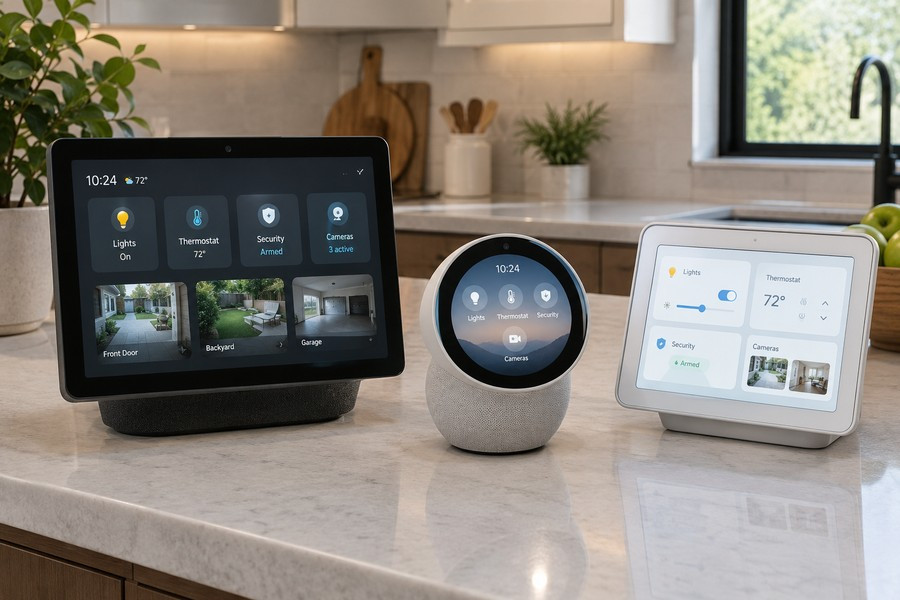
How the New Home Display Compares With Today’s Smart Screens
A new smart home display is entering a crowded market. It is designed to help people control connected devices, use a voice assistant, make calls, play music, and watch videos from around the home. Its clean design and strong connection to one popular phone and tablet ecosystem may attract buyers, but the device also has clear limits.
A Stylish Design With a Very Small Screen
The display has a low, rounded base that holds the speakers and supports a stationary screen. This design avoids the problems caused by rotating displays, which can bump into nearby objects while trying to follow a person around a room.
However, the screen measures only 7 inches. That is smaller than the screens on many competing home displays. It may work well as a bedside clock, lighting controller, or security monitor, but it is less useful as a shared family screen.
The screen produces sharp images and bright colors, yet its small size may make several tasks difficult. Watching a movie from across a kitchen, following a recipe, or making a video call could be frustrating. Small text and detailed images may be hard to see from a distance.
Larger smart displays have become popular because they can serve as small televisions or hands-free cooking guides. A screen under 8 inches usually works best when the viewer is only a foot or two away.
Wall Mounting Adds Cost and Setup Work
The display can also be mounted on a wall. This may make it easier to see, but the installation brings extra concerns. Hiding the power cable may require professional work, which can push the total cost well above the starting price.
The least expensive wall-mount accessory costs an additional $60. A wall-mounted version with a small screen may still feel limited, especially when compared with larger models that offer screens measuring 21 inches.
A large wall display can show television programs, security feeds, recipes, and family calendars more comfortably. The smaller model may be better suited to controlling lights, locks, cameras, and other connected equipment.
Voice Assistant Features Are Still Unclear
The new display uses a voice assistant that responds quickly when controlling devices in the same home system. It can also search personal messages and email for information, recipes, or other details. Users can create profiles and adjust the assistant’s speaking speed, which may help people who need slower or clearer speech.
Those features give the assistant some useful advantages. Still, it may not match the most advanced rival system for everyday conversation and outside services.
One competing assistant offers several speaking personalities and can show earlier parts of a conversation on the screen. It also connects with services that let users:
- Order food without touching the display
- Request a ride from another room
- Buy event tickets
- Make restaurant reservations
The new display’s support for similar outside services remains uncertain. Its maker has said that compatible audio and video apps from a user’s phone will work, but the full list of services is still limited.
The cost of the required subscription could also affect the buying decision. Some rival assistants charge about $20 per month for their most advanced features. A lower subscription price could make the new display more appealing.
Connected Home Controls May Be Its Biggest Strength
Setting up smart home products can be difficult. Devices may fail to connect, disappear from an app, require updates, or stop responding to commands. Even when the system works, finding the right setting can take too many steps.
The new display appears to handle setup more smoothly when used with products from the same ecosystem. Compatible devices can be found and paired with little effort, similar to connecting a new pair of wireless earbuds. The system can also recognize different household members through facial recognition or manually created profiles.
Users can move content between their phones and the display. The screen can also show a map to help locate missing devices. These small features may make the system feel more connected than competing smart home platforms.
The tradeoff is product choice. The system works best with approved locks, cameras, thermostats, lights, and plugs. Other platforms support a wider range of devices. Some products made by competing companies work only with their own systems, which can force shoppers to choose one smart home platform and stay with it.
Sound Quality Is Good, but App Support Matters More
The display includes two full-range speakers, a downward-facing woofer, and two passive radiators. The result is stronger sound than expected, although it may not match the audio quality of a larger dedicated smart speaker.
All three major types of smart displays can fill a normal room with sound. For many people, however, the more important question is whether the display supports the music services they already use.
The new device clearly supports its maker’s music service, but support for other apps is less certain. Past products from the same ecosystem have offered easy access to only a small number of outside music services.
Competing displays support broader music choices, including several major streaming platforms, internet radio services, and subscription music apps. Buyers who use a less common service should confirm compatibility before purchasing.
Video Streaming Could Be Another Weak Spot
The new display is closely tied to one video platform. Other video apps may be available, but the full selection has not been clearly explained.
Rival displays offer wider support. One platform can cast content from many popular video services, while another provides access to movies, television shows, short videos, and other streaming apps through its larger models.
Because of the small screen, limited video support could make this device a poor choice for people who want a kitchen television or everyday entertainment screen.
Price and the Tablet Alternative
The display costs $299, which is close to other top smart displays. Comparable models begin around $230 to $250, while larger wall-mounted versions can cost about $500. Discounts are also more common on competing products.
Another option is a tablet placed on a stand. A tablet offers a much larger screen, access to more apps, and the ability to leave the house or serve as a small computer. The drawbacks are price and sound quality. Some tablets cost between $600 and $750, and their speakers may not match the new display.
Overall, the new home display is most appealing to people who already use the same connected ecosystem. Its smooth device setup, personal features, and polished design are strong points. Its small screen, uncertain app support, and possible installation costs may lead other shoppers to choose a larger or more flexible device.