
Thriving Under Threat: The Struggle for Life in Occupied Ukraine
Life in parts of Ukraine that have been seized by Russia is filled with fear and hardship, as recounted by former residents and advocates. Inna Vnukova, now living in Estonia, shares her spine-chilling experience of surviving under Russian control in eastern Ukraine during the early stages of the war.
A Harrowing Escape
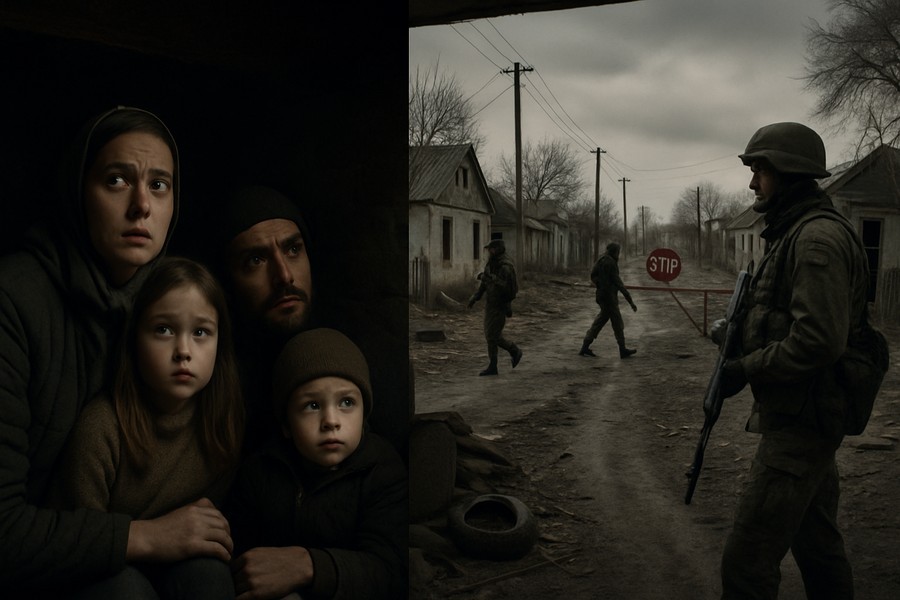
Vnukova recalls how her family was forced to take refuge in a damp basement in their village, Kudriashivka, following Russia's full-scale invasion. The soldiers roamed the streets, intimidating locals, setting up checkpoints, and ransacking homes. The fear was palpable.
Amidst the fear and chaos, Vnukova decided to escape with her 16-year-old son and her brother’s family, leaving her husband behind temporarily. Their journey to Starobilsk was fraught with danger, dodging mortar fire and waving a white sheet as a sign of peace. The memory of this ordeal haunts Vnukova to this day.
Many Ukrainians, like Vnukova, fled the hostile forces. Those who stayed faced the risk of detention, or worse, as Russian forces took control of about 20% of the country, affecting an estimated 3 to 5 million people.
Life Under Russian Control
Even after four years of war, life in occupied cities like Mariupol and villages like Kudriashivka remains challenging. There are ongoing issues with housing, water, power, heat, and healthcare. The imposition of Russian citizenship, language, and culture on the residents is another pressing issue. This is evident in school lessons and textbooks, and by 2025, about 3.5 million people in the annexed regions had been given Russian passports to access essential services like healthcare.
Life in these regions is marked by fear and oppression. Many people live in dread of being accused of supporting Ukraine. Numerous individuals have been imprisoned, beaten, and even killed, according to human rights activists.
A Family's Struggle and Survival
Vnukova's husband, Oleksii Vnukov, a court security officer, stayed behind in the village for nearly two weeks. He was threatened with death by Russian soldiers but managed to escape. The family eventually made their way to Estonia, where Inna works in a printing house, and Oleksii, 43, is an electrician.
“All life is leaving the occupied territories. The people there aren’t living, they’re just surviving,” Vnukov said.
Human Rights Concerns
Human rights groups have reported that Russian authorities used “filtration camps” to identify potentially disloyal individuals, as well as anyone who worked for the government, helped the Ukrainian army, or had relatives in the military. Journalists, teachers, scientists, and politicians were also targeted.
Stanislav Shkuta, a man who lived in occupied Nova Kakhovka in the Kherson region, recounted his narrow escapes from arrest before reaching Ukrainian-controlled territory. He was on a bus that was stopped by Russian soldiers. The passengers were asked to strip to the waist to check for Ukrainian tattoos. Shkuta now lives in Estonia and recounts how life has worsened for his friends who stayed back in Nova Kakhovka. Residents suspected of sympathizing with Ukraine are routinely stopped on the street or subjected to surprise home inspections.
Human rights advocates report that Russia has established a network of secret and official detention centers where thousands of Ukrainian civilians are held indefinitely without charges. The Ukrainian Human Rights Ombudsman, Dmytro Lubinets, estimates that about 16,000 civilians have been detained illegally, but the actual number could be much higher because many detainees are held incommunicado.
The Plight of Occupied Cities
The infrastructure in many occupied cities in eastern Ukraine has crumbled due to years of war and neglect. Cities like Sievierodonetsk and Alchevsk are struggling with problems in supplying heat, electricity, and water. Only one ambulance crew serves the whole city of Sievierodonetsk, and doctors and other health workers rotate in from Russian regions to work at its hospital.
In Alchevsk, over half the homes were without heat for two bitterly cold months. Five warming stations were set up, but over 60% of municipal heating networks are in poor shape without funds for repairs.
In the Donetsk region, water trucks deliver barrels of water outside apartment buildings which freeze solid in winter. Residents often argue over water, and those who are away at work often miss the water trucks' arrival.
In the midst of these challenges, Inna Vnukova is building a new life in Estonia with her husband, Oleksii, and their 1-year-old daughter, Alisa. They dream of returning to their homeland someday, but they are unsure of what they will find there. "We've been dreaming of returning for four years, but we increasingly wonder — what will we see there?" she asked.