
A Closer Look at Our Closest Star: High-Tech Images Reveal New Secrets of the Sun
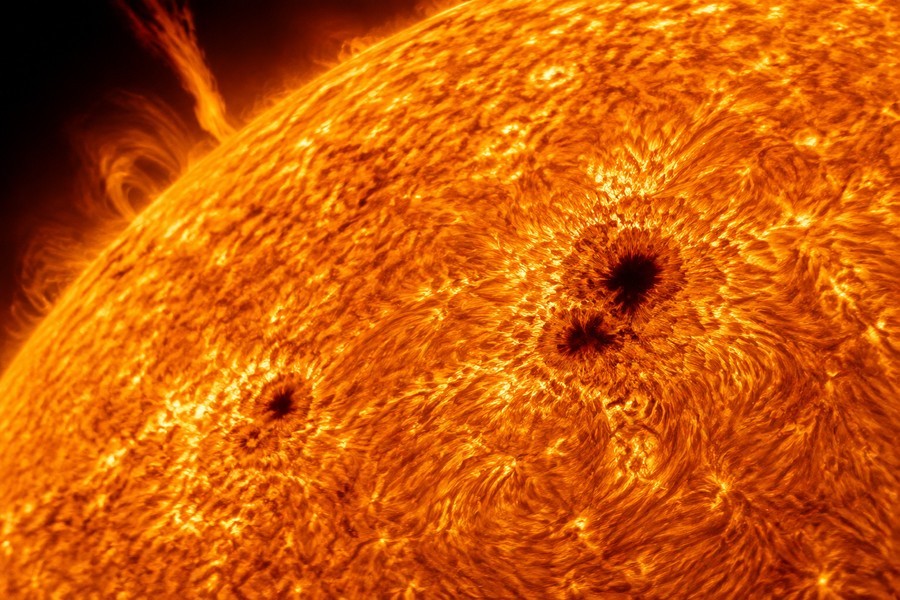
The sun is the center of our solar system, providing light and warmth to our planet every single day. However, looking directly at this bright star is highly dangerous and can cause permanent eye damage. Because of this, researchers must rely on specialized equipment to study the sun safely. Recently, scientists used a powerful solar telescope located on the island of Maui in Hawaii to capture the most detailed images of the sun’s surface ever seen, revealing a surprising and active environment.
An Unexpected Scientific Breakthrough
The incredible pictures were not actually part of a planned study of the sun's surface. Instead, researchers originally took the photos for a much simpler reason: they needed to test the limits of the telescope and fine-tune its settings.
When the team examined the results of their test, they discovered they had captured something extraordinary. The images showed the bright outer shell of the sun in a much higher resolution than any previous photographs. The level of detail allowed them to see features on the solar surface that had never been visible before, turning a routine equipment test into a major scientific achievement.
Swirls, Waves, and Cosmic Art
The new images show that the surface of the sun is not a smooth, uniform ball of light. Instead, it is filled with strange, feathery patterns that ripple across the hot outer layer.
To some experts, these moving patterns look less like science and more like art. One solar physicist noted that the swirling designs on the sun's surface look very similar to famous paintings, particularly the famous swirling night skies painted by Vincent van Gogh.
These beautiful patterns are actually caused by the movement of magnetized plasma. Plasma is a super-hot, gas-like state of matter that makes up the sun. The ripples occur when different sections of this plasma slide past each other at different speeds.
This movement creates a specific type of physical instability, which is very similar to the way wind creates waves when it blows across the surface of a quiet lake.
A Common Force in the Universe
While this type of fluid movement is a well-known scientific concept, seeing it on the sun in such high detail is brand new. This type of motion has been observed in many different places, including:
- On Earth: In our own atmosphere and oceans, where wind and water interact.
- On Jupiter: In the swirling gas clouds of the giant planet.
- On Saturn: Within the windy atmosphere of the ringed planet.
Even though scientists knew this phenomenon existed throughout the solar system, it had never been captured at such a highly detailed level on the surface of the sun until now. The details of these findings were shared with the public in a prominent scientific journal.
Why Studying the Sun Matters to Us on Earth
Learning about the inner workings of the sun is not just about taking beautiful pictures. It is also highly important for protecting our technology on Earth. Scientists study the sun's surface to better understand and track massive releases of energy known as coronal mass ejections.
These events happen when the sun releases giant bursts of energy and plasma into space. If these bursts are directed toward Earth, they can cause several noticeable effects:
- Solar Storms: These storms can interfere with magnetic fields around our planet.
- GPS Disruptions: The energy from the sun can scramble satellite communications, making navigation systems less accurate.
- Beautiful Auroras: On the positive side, these solar events can create stunning light displays in the night sky, commonly known as the Northern and Southern Lights.
By studying the sun's surface at such a high resolution, scientists hope to gain a better understanding of how these energy bursts form, which could help us prepare for solar storms in the future.