
How Farming Once Created Thousands of Now-Lost Languages
Today, people around the world speak more than 7,500 distinct languages. While that might seem like a massive number, it is actually much smaller than the number of languages humans used to speak. Long ago, the world was filled with a vast web of different tongues. New research suggests that between 1,000 and 3,000 years ago, tens of thousands of languages existed across the globe. Over time, the vast majority of these ancient ways of speaking simply disappeared.
This massive decline reveals that language loss is not just a problem of the modern world. Instead, the rise and fall of human speech has been happening for thousands of years. The biggest driver of this language explosion was a major shift in how humans lived: the birth of agriculture.
How Farming Changed the Way We Talk
Before humans learned to farm, they lived as nomadic hunter-gatherers. These groups moved constantly to find food, following animal herds and seasonal plants. Because they were always on the move, they frequently interacted with other groups, which kept their languages somewhat connected.
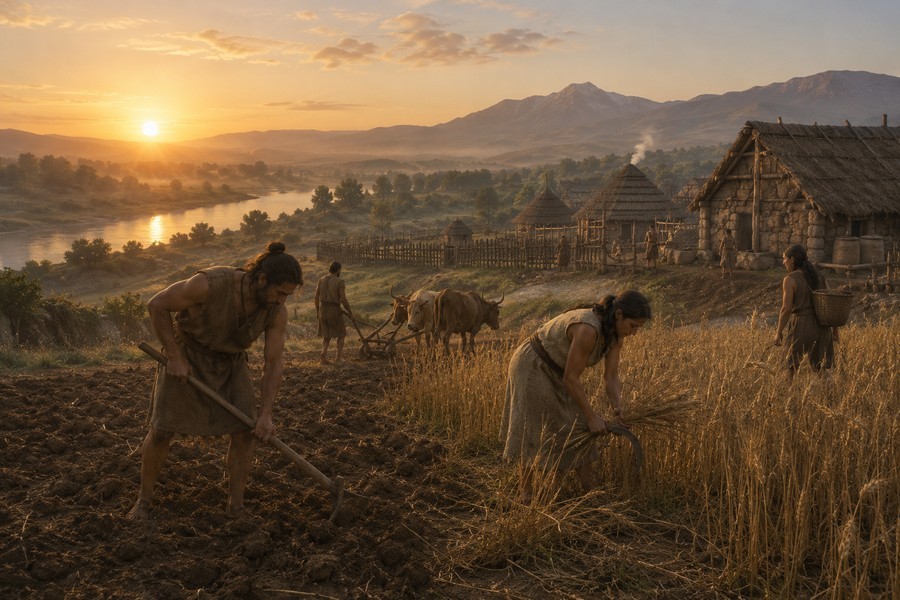
Everything changed when people started planting crops and raising animals. Instead of wandering, human groups settled down in one place. They built permanent homes and lived in small, isolated farming villages. Because these early farming communities had very little contact with the outside world, their speech began to change. Over generations, these isolated groups developed their own unique ways of talking, leading to a massive boom in the total number of languages spoken worldwide.
Reconstructing the Sounds of the Past
It is very difficult for experts to study how people spoke thousands of years ago. Unlike bones or stone tools, spoken words do not leave physical clues in the dirt. Without written records, figuring out how many languages existed in the deep past requires creative math and advanced computer models.
To solve this puzzle, researchers looked back 12,000 years to the end of the last ice age. They estimated the total number of people alive on Earth at that time. Then, they divided that population by the average size of a typical hunter-gatherer group. To make this calculation, they assumed that a single language group consisted of about 800 people. This estimate was based on historical studies of native groups in cold, northern regions and other global language patterns.
Using this math, the researchers estimated that between 3,300 and 7,800 languages were spoken at the end of the ice age. This laid the groundwork for understanding how human speech multiplied over the next several thousand years.
The Peak of Human Language
As farming spread across different continents, the number of languages grew rapidly. The peak of this linguistic diversity happened around 2,000 years ago. At that point in history, tens of thousands of languages were spoken globally. This was roughly ten times the number of languages that existed at the end of the ice age.
However, this peak did not last forever. As small farming communities grew, they began to merge. Over time, these communities formed larger societies, kingdoms, and eventually modern nations. As these groups grew bigger, they adopted common languages to communicate, trade, and govern. This caused many smaller, local languages to die out.
The history of human language can be broken down into a few key stages:
- The Ice Age Era: Humans lived in small, wandering groups, speaking thousands of different languages.
- The Agricultural Boom: People settled into isolated farming villages, causing the number of unique languages to skyrocket to its highest level in history.
- The Rise of Large Societies: Villages merged into larger nations, leading to the loss of thousands of local tongues as dominant languages took over.
Today, we live in a world dominated by a relatively small number of major languages. While the loss of ancient languages might seem like a modern trend driven by technology and globalization, history shows us that it is a process that began thousands of years ago when the very first seeds were planted in the ground.