
Protests in Albania Turn Violent as Calls for Prime Minister to Resign Grow
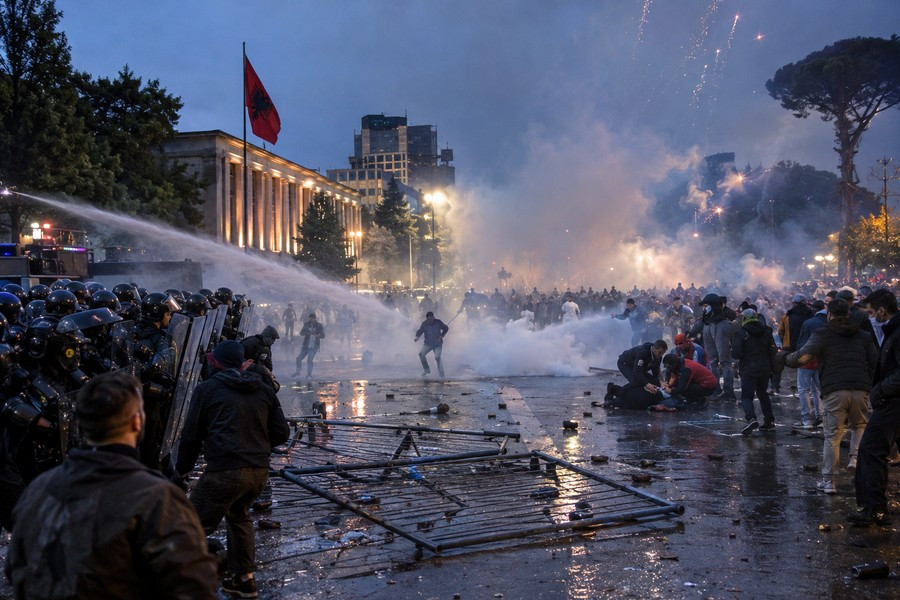
Clashes between protesters and police in Albania’s capital have left hundreds injured and led to dozens of arrests. The demonstrations are aimed at Prime Minister Edi Rama, whom protesters accuse of allowing corruption to spread through the government. They want him to resign, but Rama has said he will stay in office.
Police and Protesters Clash in Tirana
The protests have taken place daily since they began in May. A recent evening of demonstrations was among the most violent so far. Some protesters wore black clothing and masks and fired fireworks from long tubes toward police in riot gear.
Police responded with rubber bullets, tear gas and water cannons. Protesters said officers used force against them, while the clashes left many people hurt on both sides. One protester, Elsa Biya, said a stun grenade hit her and a rubber bullet struck her shoulder.
Biya, who is 33, said she wants to live in Albania with dignity. She believes the country’s government is deeply corrupt and described it as operating like a mafia. She also said people feel that their land and water are being taken from them.
For Biya, the violence has created more room for the government to use force against demonstrators. She and other protesters say they are asking for a normal, fair country where people can live without being pushed aside.
Anger Goes Beyond a Resort Plan
The demonstrations first focused on a planned luxury resort along a protected coastal area. The project was connected to the son-in-law of the U.S. president. Over time, the protests grew into a wider challenge to corruption and Rama’s leadership.
Many demonstrators say the resort plan reflects a larger problem: decisions about Albania’s land and resources are being made without enough concern for ordinary people. Their demands now reach beyond the proposed development and include changes to the country’s government.
Sofia Katroshi, a 66-year-old protester, has taken part in the demonstrations for months. She said her daughter, who lives in England, does not want to return to Albania because of the corruption she sees at home.
Katroshi said Rama has not listened to the public. She believes that people without money have little power in the country, and she accused the prime minister of leading a system controlled by criminal interests. She also said the rise in violence is justified because peaceful appeals have not brought a response.
More Groups Join the Demonstrations
The protests have drawn people from several professional groups, including doctors and professors. Their participation shows that opposition to Rama is not limited to the young people who have been prominent in the demonstrations.
Rama has rejected calls to step down. He has offered extra cash to police officers working on the front lines and arranged pillows and chairs outside his building as an invitation for people to talk with him.
Those gestures did not ease tensions during the violent clashes. Angry protesters set the pillows and chairs on fire amid the disorder in Tirana.
Regional Political Tensions
The unrest in Albania is unfolding in a region where political movements have also challenged leaders elsewhere. In neighboring Serbia, a pro-Russia leader was removed from power through an election. A student-led movement there has protested government corruption for nearly two years.
In Albania, demonstrators continue to demand that Rama leave office and that the country address corruption. The government has not agreed to the main demand, and recent clashes have deepened the divide between protesters and police.