
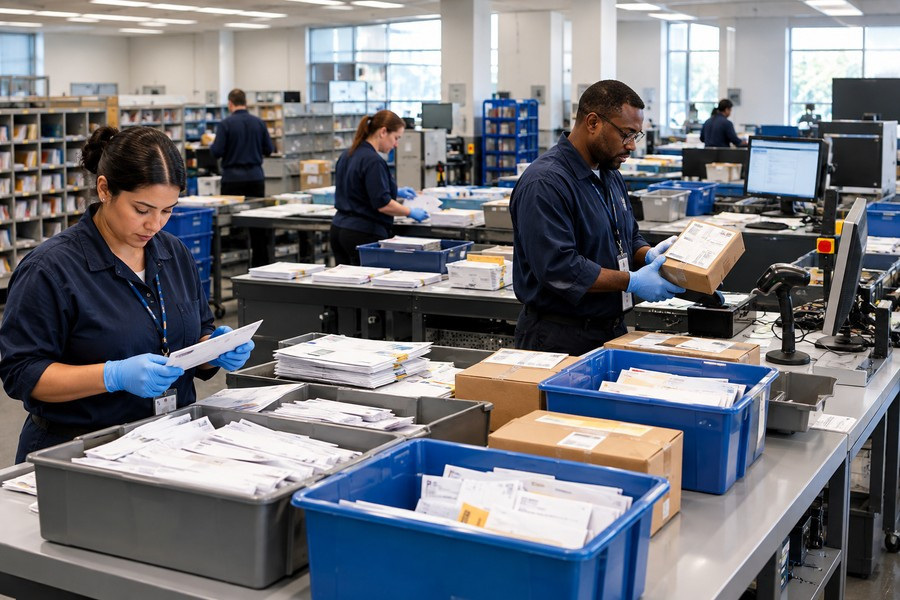
Stopping Unneeded Mail Could Save Government Time and Money
Government agencies have spent many years making office tasks faster and less costly. They have updated their technology, systems, and work processes. But there is another way to improve efficiency: stop work that does not need to happen before it reaches government offices.
This kind of work is called administratively unnecessary work, or AUW. It uses government time and resources but could have been prevented before entering the usual workflow. The goal is not just to handle this work more quickly. It is to keep it from arriving in the first place.
A Different Way to Handle Commercial Mail
The State Department tried this approach with unwanted commercial mail. Its Diplomatic Pouch and Mail Division reviewed incoming mail at two sites. One site, SA-32, handles mail for embassies and consulates around the world. The other, HST, serves domestic offices in Washington, D.C.
The teams found that a large share of the commercial mail was not needed for the department’s mission. They worked with the businesses that produced the material and asked them to stop sending it. This helped prevent unwanted mail from being made and shipped to overseas missions and offices in Washington.
Over a little more than two years, the two operations eliminated 1.41 million pieces of commercial mail. The State Department continues to use this method. Its logistics team tracks mail volumes so the effects on operations and sustainability can be measured.
An estimate based on the reported drop in mail volume, Postal Service cost estimates, and conservative shipping costs puts the operational savings at more than $5 million.
Fewer mail pieces also mean less work after delivery. Staff need less time to receive, sort, distribute, and handle material. The offices also use less storage space and equipment, and have less to dispose of. Each task may seem small, but together they use staff time and taxpayer-funded resources.
Results at Air Force Installations
The same technology was tested at five Air Force installations: Davis-Monthan Air Force Base, Keesler Air Force Base, Maxwell Air Force Base, Sheppard Air Force Base, and Patrick Space Force Base.
All five sites reduced their mail volume. Documented reductions reached as high as 70 percent. The pilots were carried out with support from the Air Force Installation and Mission Support Center in San Antonio, Texas. They examined whether the technology could reduce unwanted commercial mail entering the installations.
The results suggest that this is not only a mailroom concern. Preventing unnecessary mail can affect staffing, office space, equipment, and waste across an organization.
Efficiency Starts Before Processing
When unnecessary work enters a federal agency, it can set off a chain of tasks. Employees may receive, sort, distribute, process, store, and sometimes reship materials before finally throwing them away. Those steps use people, space, and equipment even when the material did not need to arrive.
Making each step faster can help, but it does not remove the original cost. An agency may become very good at processing work that offers little or no value. The more basic question is whether that work should enter the agency at all.
Why Unnecessary Work Continues
The employees who handle a task may not have the authority or information needed to stop it. Their jobs often focus on completing assigned work efficiently, not deciding whether the work should exist. As a result, a process can run smoothly while still using resources on something the government does not need.
Solving the problem may require action from leaders because the effects reach beyond one team. Mail handling, administration, storage, facilities, and disposal can all be involved. When the costs fall across different offices, no single group may be able to make the full decision alone.
A Governmentwide Question
Technology can help agencies spot unnecessary work and prevent it at its source. The next step could be a governmentwide review of how much AUW enters federal operations and how much could be stopped before staff and equipment are committed.
Such a review would not begin by simply looking for cuts. It would ask whether the work provides enough value to justify the resources needed to receive, process, store, or dispose of it. Then it would consider whether the work can be prevented before it reaches government employees.
The focus would shift from doing every task more efficiently to deciding which tasks need to be done at all.