
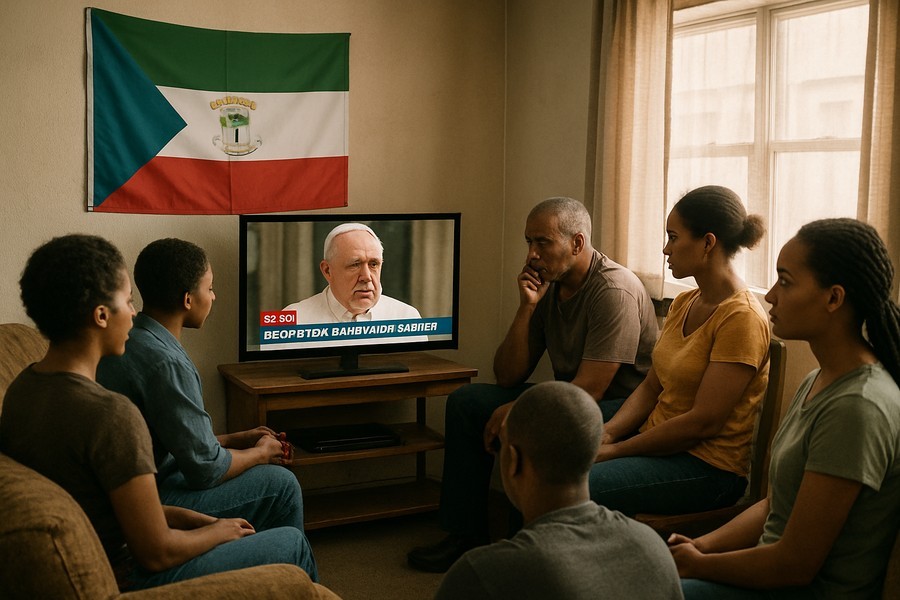
Concerns Over Papal Visit Granting Credibility to Equatorial Guinea's Leadership
For those who escaped from Equatorial Guinea due to allegations of government oppression and minority abuse, the pope's trip to their homeland raises concerns. Specifically, a 59-year-old cook named Gutïn Bae Tongala, who fled to Spain in 2002, is worried that the visit might be used to sanitize the image of the ruling family which has been in power for decades.
Equatorial Guinea's Catholic Majority
Equatorial Guinea is home to one of the highest percentages of Catholics in Africa, with about 75% of the population identifying as Catholic. The pope's visit to this nation is the final stop in his four-country tour of the continent, which also included Algeria, Cameroon, and Angola.
During his time in Equatorial Guinea, the pope has condemned the exploitation of Africa's mineral resources and the rampant desire for power. He called on the nation to strive for justice and to work towards reducing the divide between the privileged and the disadvantaged.
Concerns Over Misuse of Papal Visit
Those who fled the nation, including Tongala, express concerns that President Teodoro Obiang Nguema Mbasogo, who has been in power since 1982 and is the longest-serving president in Africa, may leverage the papal visit to portray his government in a positive light. These concerns stem from allegations of a repressive regime leveled against the government by activists.
The Influence of the Catholic Church in Equatorial Guinea
While Equatorial Guinea is officially a secular country, the Catholic Church plays a crucial role in its political and social systems. This is a legacy from the time of Spanish colonization. Churches in the country operate educational centers, hospitals, and social spaces for the nearly 1.9 million residents.
Even state ceremonies such as presidential inaugurations and Independence Day celebrations incorporate a Catholic Mass. In 2011, for example, President Obiang was inaugurated in a large neo-Gothic Basilica in his hometown, Mongomo. The Basilica, which is modeled on St. Peter’s Basilica and Square at the Vatican, is the largest religious building in Central Africa and the second largest in the continent.
Some critics argue that the church is closely intertwined with the government, a relationship which is driven by both fear and potential monetary gains.
Denial of Rights Violations
Despite accusations of rights abuses, Equatorial Guinea's Justice Minister has stated that the country's prison and justice systems adhere to international human rights laws. He praised the nation's infrastructure and claimed that it is well-prepared to safeguard human rights and fundamental freedoms.
However, a 2024 report by Amnesty International detailed what it called "widespread use of arbitrary arrests, torture, and other ill-treatment" in the country. In addition to this, the president's son was investigated by the Spanish high court in the same year over the alleged kidnapping and torture of two opposition leaders who held Spanish citizenship.
Hope for a Stronger Stand Against Repression
Many are urging the pope to use his influence to speak out against the repression and abuses allegedly occurring in Equatorial Guinea. According to the World Bank, over half the population lives in poverty, and rights groups have accused the government of using the nation's oil wealth primarily to enrich the president's family.
Despite these allegations, some believe that the president is using the pope’s visit as a way to gain legitimacy amid growing discontent over his family's stranglehold on power.
Jorge Awal, a 27-year-old who now works in the private sector in Spain, expressed his hope that the pope will defend the Christians living in Equatorial Guinea who, he believes, suffer daily human rights abuses under the orders of President Obiang Nguema.