
A Tiny Optical Sensor Could Bring Lab-Quality Testing to Wearable Devices
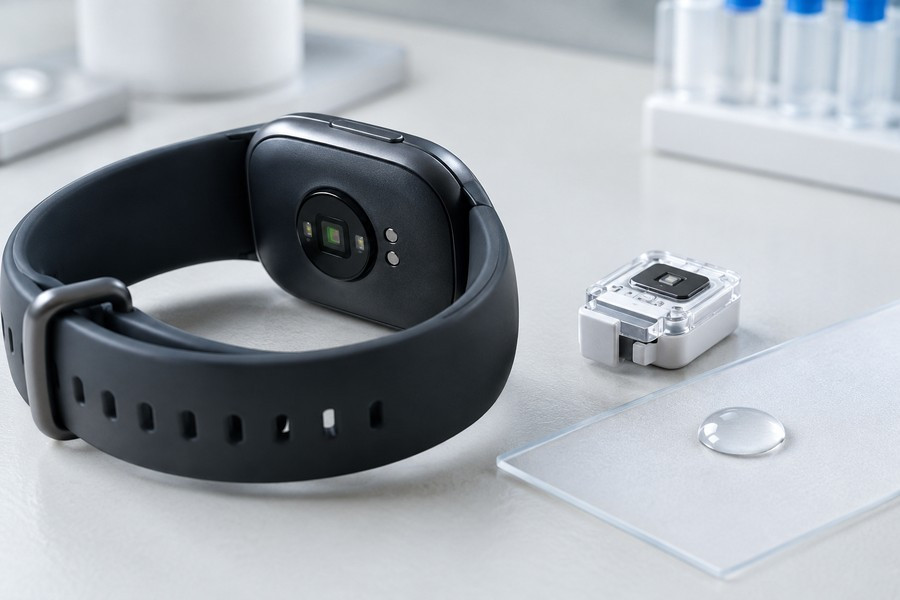
A new optical sensor combines high accuracy, small size, and a cost of about $10. The device is only a few centimeters wide, yet it can study light and use that information to identify materials, measure chemical levels, and track health signals.
The technology could one day be built into smartwatches, medical wearables, factory equipment, food-testing tools, and outdoor sensors. It may help bring measurements that usually require large laboratory machines into smaller, cheaper devices.
How the Miniature Sensor Works
Optical spectrometers examine how light interacts with a substance. Each material changes light in its own way, allowing the instrument to reveal information about chemicals, medicines, food, plastics, and the human body.
These instruments are used in healthcare, manufacturing, environmental testing, and chemical research. However, shrinking a spectrometer has usually created problems. Smaller designs often measure fewer wavelengths, provide less detail, or lose accuracy. Many compact devices can identify a substance but cannot measure its exact concentration well.
The new design uses a different method called a convolutional spectrometer. Instead of simply separating light into its individual colors, the device applies a mathematical operation directly to the incoming light. The system then uses fast Fourier transforms to rebuild the light spectrum.
To make this possible, the engineers arranged optical parts with repeating responses to different wavelengths. These parts may include specially designed interferometers or tiny ring-shaped resonators. Their responses can be adjusted in a controlled pattern, allowing the sensor to examine a wide range of light.
Wide Range and Fast Measurements
The device was built on a silicon nitride photonic platform and connected to built-in electronics. It works with near-infrared light from 1,200 to 1,700 nanometers. A measurement can be collected and processed in less than one second.
The design can also grow without requiring a complete hardware replacement. Adding more repeating optical parts can increase the sensor’s resolution by a large amount. The pattern-based system may also allow the device to cover a much wider spectral range as more components are added.
Testing showed that the sensor remained reliable in temperatures ranging from -20 degrees Celsius to 80 degrees Celsius. That level of durability could make it useful in outdoor equipment, industrial systems, and wearable devices exposed to changing conditions.
Strong Results in Material and Chemical Tests
The sensor was tested with several common materials and substances. These tests showed that it could perform tasks normally handled by larger and more expensive laboratory instruments.
- It correctly classified plastics, medicines, coffee, flour, and tea in every reported test.
- It measured concentrations in water-based and organic liquids with an accuracy of about 0.01%.
- It performed better than laboratory-sized spectrometers in the concentration tests.
- It continued working across a broad range of temperatures.
These results suggest that the device could be used for checking products, identifying unknown materials, and monitoring chemical changes. Food producers might use similar sensors to examine quality or freshness. Manufacturers could place them along production lines to check materials continuously.
Possible Uses in Health Monitoring
The sensor also measured several human health markers under conditions designed to resemble real biological environments. Tests included skin moisture, blood alcohol, blood lactate, and blood glucose.
In one demonstration, the device tracked glucose without piercing the skin over an extended period. More research and testing would be needed before such a system could become a medical product. Still, the result points to a possible way to monitor blood sugar without repeated finger pricks or needles.
Future wearable devices could potentially use similar technology to measure hydration, follow changes linked to exercise, detect alcohol, or track other body signals. People managing diabetes might eventually benefit from continuous glucose monitoring that does not require frequent skin contact or disposable test strips.
Less Computing Could Make It Easier to Use
Many small spectrometers depend on complex calibration steps and powerful software. They often reconstruct a spectrum through demanding calculations. Noise or changes in operating conditions can make those systems less reliable.
The convolution-based design reduces much of this complexity. Its measurements follow a linear mathematical relationship, allowing the spectrum to be recovered quickly with relatively little computing power. That could help the sensor operate inside low-power devices such as watches, patches, handheld tools, and battery-powered monitors.
Its simpler structure may also support large-scale manufacturing. If production costs remain close to $10, advanced optical testing could become practical in places where traditional spectrometers are too large or expensive.
A Path Toward Everyday Chemical Sensing
The technology could eventually make spectrometry as common as temperature or motion sensing. Factories might use networks of inexpensive sensors to monitor products and materials. Food companies could check freshness, while environmental equipment could examine air, water, or soil conditions.
Although additional testing is needed before widespread use, the miniature spectrometer shows how mathematical design and photonic engineering can work together. By combining precision, speed, durability, and low cost, the device offers a possible way to place laboratory-quality chemical sensing inside the everyday electronics people already use.