
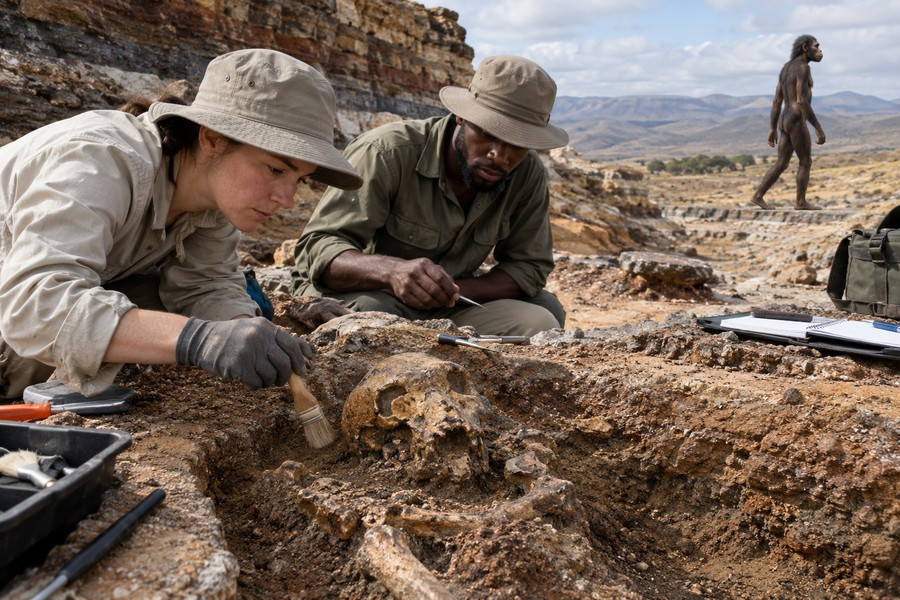
Ancient Human Relative May Have Appeared Much Earlier Than Scientists Thought
A New Look at Early Human Evolution
A new study of fossils from South Africa suggests that Homo erectus, an early human relative, may have appeared about two million years ago. That is roughly 200,000 years earlier than many earlier estimates.
The finding helps fill in an important part of the human family tree. Homo erectus is often recognized as one of the first hominins to show clear signs of living more successfully on the ground. Its body had longer legs and shorter arms, features that made walking over long distances easier. The species name means “upright human.”
The evidence comes from the Drimolen Main Quarry, a major fossil site near Johannesburg in South Africa. The area is part of the region often called the “Cradle of Humankind” because it contains many remains from early human relatives.
An Adult Fossil Adds Important Evidence
The central discovery is an adult fossil known as DNH 127. Its shape and structure match the physical features linked to Homo erectus. Because it comes from an adult, it offers stronger evidence than an earlier skull fragment from the same period that belonged to a young child.
Studying adult fossils is important because children’s bones are still growing. Their features can look different from those of fully developed individuals, making it harder to compare them with fossils from other species.
The researchers examined 18 fossils from the site. They studied the shape and physical details of the bones to identify the species. They also used geological methods, including radioactive dating, to estimate how old the remains were.
Two Species Shared the Same Area
The study also examined fossils from Paranthropus robustus, a more distant relative of modern humans. Fourteen of the fossils were linked to this species, which had a powerful jaw and large teeth suited for chewing hard and tough foods.
The two species lived in the same general area and were both preserved in the Drimolen cave. Their bodies, however, were changing in very different ways.
- Homo erectus was developing a larger brain and smaller teeth.
- Paranthropus robustus was developing larger teeth and stronger chewing muscles.
- The jaw shape of Paranthropus robustus shows that it was built to handle difficult foods.
- Both species existed in the same landscape at the same time.
Even though Homo erectus eventually became part of the line that led toward modern humans, it may have been much less common at Drimolen. The remains found there suggest that Paranthropus robustus outnumbered Homo erectus by more than ten to one.
Fossils Show Evolution Was Not Simple
The new remains support the idea that Paranthropus robustus changed over time. Fossils from other locations had already shown that later members of the species were larger and more powerful. The Drimolen fossils add new details to that picture.
Several of the newly studied bones show jaw features that had not been seen clearly before. They also reveal a wider range of physical differences within the species. This variation gives scientists a closer look at how small changes built up across many generations.
The discovery also highlights how complicated early human evolution was. Ancient human relatives did not always appear in a neat line, with one species replacing another in a simple sequence. Several species often lived in the same region at the same time, competing for food and space while following different evolutionary paths.
More Evidence May Still Be Buried
The fossils from Drimolen are mostly small or incomplete pieces, so more work is needed to confirm the early presence of both species. Still, the site contains a large collection of remains, and additional fossils may be found in the future.
Those discoveries could help explain why the Paranthropus robustus branch eventually disappeared while the Homo erectus line survived. They may also show how early members of the human family adapted to changing food sources, landscapes, and living conditions.
For now, the evidence suggests that Homo erectus appeared earlier than once believed. At the same time, its future was far from certain. In the same environment, Paranthropus robustus was much more common, making the later success of the Homo erectus line difficult to predict.