
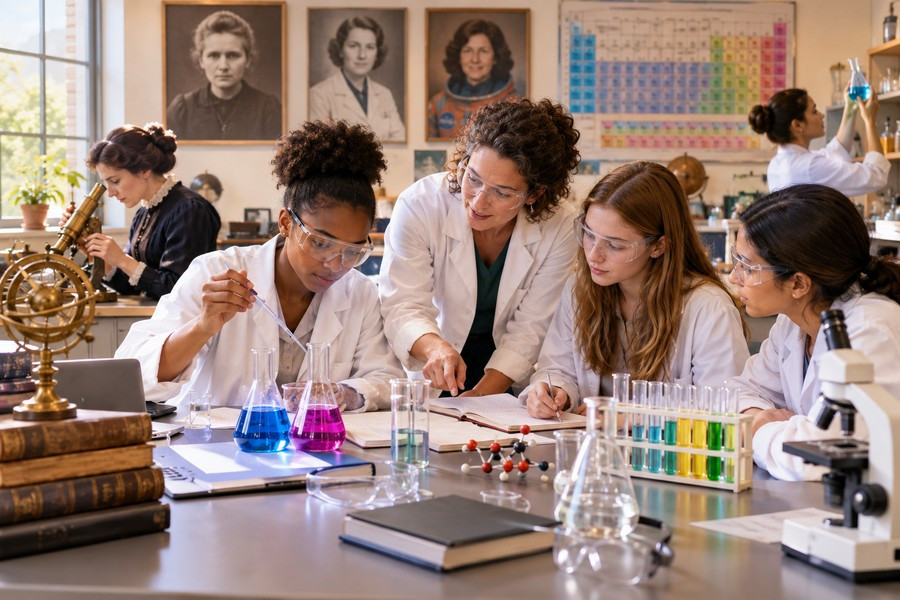
Women Scientists Missing From Key School Lessons
Think back to a typical science classroom: glowing Bunsen burners, cloudy safety glasses, and a large periodic table on the wall. The lessons may have covered discoveries that changed the world, but the people named in those lessons were usually men.
Students often learn about Newton’s laws, Darwin’s theory of natural selection, and other major ideas without hearing about the women who also helped shape modern science. This is not simply a matter of what one teacher chooses to include. The gap is built into the official course requirements used for major school exams.
A Narrow View of Scientific History
A review of more than 40 science course specifications examined the material required for GCSEs, A-levels, and Scotland’s National 5 and Higher exams. The review looked at the courses offered by six main exam boards and counted 224 different scientists.
Only three women were named across all of those course documents. Most scientific discoveries were connected to ideas, laws, or measurements named after men.
The small number of women who appeared were included in limited parts of the curriculum:
- Inge Lehmann is named in advanced geology lessons for discovering that Earth has a solid inner core surrounded by a liquid outer core. This boundary is known as the Lehmann discontinuity.
- Marie Tharp appears in geology lessons for mapping the ocean floor and identifying the rift valley along the Mid-Atlantic Ridge. Her work helped support the theory of continental drift.
- Rosalind Franklin is included in biology courses for her X-ray crystallography research, which revealed important information about the double-helix structure of DNA.
Franklin is the only woman named in the compulsory science courses taken by all students at the GCSE level. At the A-level stage, Lehmann and Tharp appear only in geology, a subject chosen by fewer than 2% of science students.
Important Work Often Taught Without the Women Behind It
Women faced serious social, financial, and institutional barriers that limited their ability to study and work in science. Even so, many made discoveries that are already part of lessons for students ages 14 to 18.
The problem is that the women behind those discoveries are often left out. Students may learn the scientific idea without learning who helped create it, test it, or explain it.
Franklin’s work is one example. Her research provided essential evidence about DNA’s structure, but her data was used without giving her proper credit during her lifetime. Tharp also faced discrimination. She was kept from joining research ships for years, and some people dismissed her ideas as “girl talk.”
Why Classroom Representation Matters
Women make up only about one-third of the world’s scientific community, with similar numbers in the UK science workforce. The imbalance begins during school years.
Science participation is fairly even among boys and girls in earlier secondary education. However, the number of girls falls in advanced courses. Girls make up 24.1% of physics students, 37.3% of mathematics students, and 26.9% of further mathematics students at the later school level. Women also represent about 25% of physics undergraduates at UK universities.
Seeing women connected to major discoveries can help students feel that science is open to them. Female role models can build confidence and create more positive views of scientific careers.
Teachers may want to include more women in their lessons, but exam specifications control much of what must be taught. Adding extra scientists can take time in classrooms already filled with required material. As a result, teachers are often left to make those additions on their own.
Scientists Who Could Be Added
Small changes to required courses could make the history of science more complete. One practical idea is to add at least one woman to each subject area while keeping the existing topics and lessons.
- Marie Skłodowska-Curie could be taught alongside atomic structure and radioactivity. She created the term “radioactivity” and discovered polonium and radium.
- Lise Meitner could be included in lessons about nuclear fission. She provided the first theoretical explanation of how the process works.
- Jocelyn Bell Burnell could be added to astronomy lessons because she discovered pulsars, which are rotating neutron stars that act like cosmic clocks.
- Dorothy Hodgkin could be discussed during lessons on protein structure. She was the only British woman to win a Nobel Prize in science.
- Tu Youyou could be included in biology lessons for work that led to an important medicine used to fight malaria.
- Stephanie Kwolek could be taught in chemistry lessons about polymers because she invented Kevlar.
- Annie Jump Cannon could be included when students learn how stars are classified.
- Susan Solomon could be discussed in environmental science lessons for her major work on the loss of ozone over Antarctica.
A More Complete Science Education
Adding these names would not require schools to replace the science already taught. It would give students a fuller picture of how discoveries happen and who makes them.
When course requirements include women as part of the main story, representation becomes a normal part of education instead of an extra task for teachers. Every student should be able to see a place for themselves in science and understand that its history was shaped by people from many different backgrounds.