
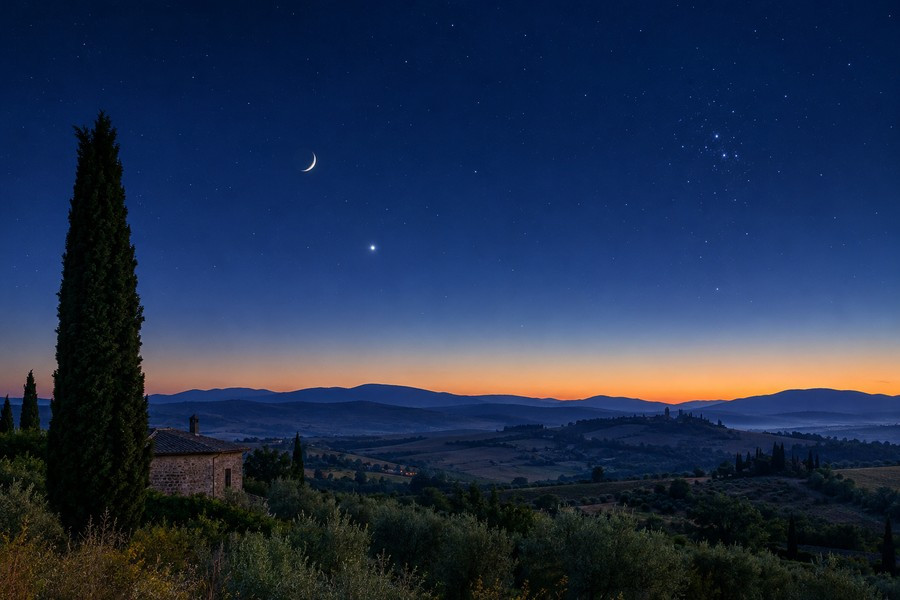
New Clues Point to a July Morning Behind The Starry Night
Vincent van Gogh’s The Starry Night is one of the most recognized paintings in the world. Its bright stars, deep blue sky, tall cypress tree, and rolling hills have inspired music, clothing, books, and countless visitors to art museums.
Now, a detailed study of the sky in the painting points to a specific moment that may have inspired van Gogh. The scene most closely matches the early morning sky over southern France on July 22.
A Sky Filled With Clues
The painting shows several important features that can be compared with real objects in the night sky. These include a thin crescent moon, the bright planet Venus, and a group of stars known as the Hyades. The Hyades are found in the constellation Taurus.
Researchers used the positions of these objects to study when they would have appeared together above the landscape near Saint-Rémy-de-Provence. Their calculations showed that the arrangement matched the painting around dawn on July 22.
The moon’s shape also supports this conclusion. Earlier ideas connected the painting with a night in June, but the moon during that period would have appeared too full. By late July, the moon had become a slender crescent, much closer to the shape shown in van Gogh’s work.
Van Gogh’s View From the Asylum
Van Gogh painted The Starry Night while staying at a medical facility in southern France. He spent about a year there while seeking help for serious mental health problems and epilepsy.
The view from his room offered hills, trees, and a wide stretch of sky. However, the small village in the lower part of the painting could not be seen directly from his window. Van Gogh built that part of the scene from other views and from his own imagination.
He also changed the sky. The stars and moon were based on real objects, but he made them larger, brighter, and more dramatic. The swirling lines in the sky create a feeling of movement that would not appear in an ordinary view of the heavens.
The painting is both an observation of nature and an emotional interpretation of it. Van Gogh used strong blues and yellows to show more than what the eye might see. His brushstrokes give the sky energy, motion, and a powerful sense of life.
How the Investigation Worked
The effort to identify the sky in The Starry Night has continued for many years. Earlier researchers suggested different constellations and different times of year. Some believed the stars had mainly religious or symbolic meanings rather than being tied to a real moment.
The new investigation used several types of evidence:
- Computer models showing where the moon, Venus, and stars appeared in the sky
- Measurements of the positions of stars and planets
- Weather records from the area
- Letters written by van Gogh
- Earlier landscape sketches used to estimate the direction of his view
When these details were combined, the late-July explanation became the strongest match. The crescent moon, Venus, and the Hyades would have appeared near one another before sunrise. The sky was also likely clear enough for the objects to be visible.
Heat and Cicadas Add More Support
Van Gogh wrote often about cicadas during his time in the region. These insects are common during hot weather. Local temperature records fit a period of July heat better than the cooler conditions expected in June.
That detail does not prove the exact night by itself, but it adds another piece to the larger picture. The stars, moon, weather, and van Gogh’s letters all point toward the same period.
Other Paintings May Hold Similar Secrets
The researchers also tested their approach on other nighttime paintings by van Gogh. In Starry Night Over the Rhône, the star pattern appears to match the constellation Aries when compared with the view from the actual location.
Another painting, Café Terrace at Night, may show stars from the Summer Triangle. That group is made up of three bright stars that are easy to spot in the summer sky.
These comparisons suggest that van Gogh sometimes studied real skies closely before reshaping them through color and brushwork. His paintings may combine careful observation with imagination, memory, and emotion.
A More Complete Picture of the Painting
The July explanation does not remove the mystery of The Starry Night. Instead, it adds another layer to the work. The painting remains highly personal, but parts of its sky may be connected to a real morning that van Gogh could have seen from his room.
Researchers hope that more studies will examine the order in which van Gogh created his paintings, the places he visited, and the skies he may have observed. Each painting could offer new clues about how he turned ordinary landscapes into some of the most memorable images in modern art.