
China’s Anti-Corruption Drive Keeps Party Discipline in Focus
China’s leader, Xi Jinping, began a campaign against corruption when he took power. The effort has continued for more than a decade. In the past year alone, disciplinary agencies opened investigations into more than one million people. More than 100 of them held jobs at or above the provincial or ministerial level.
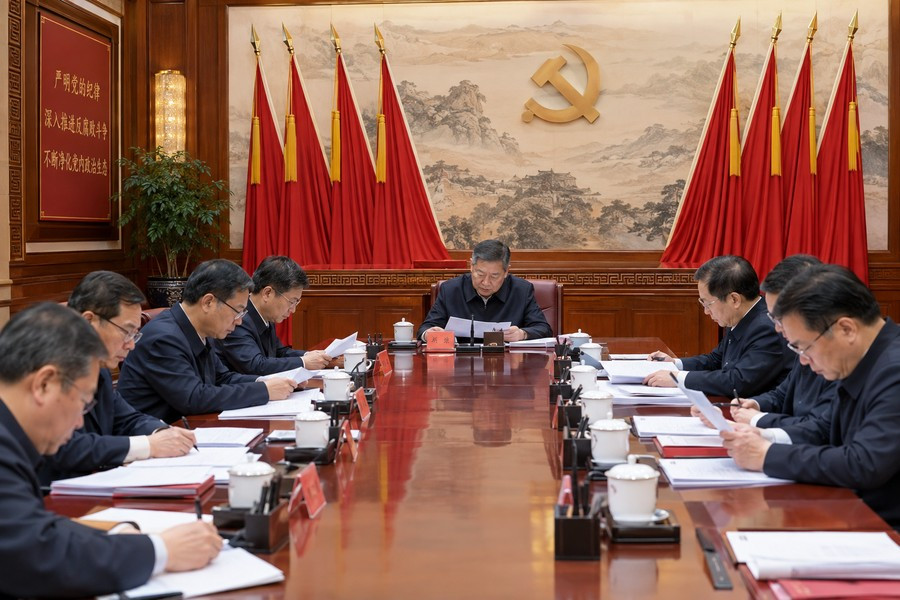
Now, senior Communist Party officials are meeting to discuss how to enforce discipline and keep members loyal. The gathering is part of a series of meetings held during each five-year period between party congresses. More than 300 members of the party’s Central Committee are taking part.
Discipline Means More Than Following Rules
The meeting is focused on what the party calls strict self-governance. That phrase covers efforts to fight corruption, enforce party rules and promote loyalty to the leadership.
Under Xi’s approach, corruption and political disloyalty can be closely linked. Party members are expected to put the party’s goals first. Officials who act in their own interest may be seen as a threat, even when the issue is not simply money or personal gain.
This view also gives the anti-corruption campaign a broad reach. Misconduct can include taking money, but it can also mean failing to show the right level of loyalty. That makes discipline a central part of how the party governs.
A Campaign With No Clear End
China’s government oversees a population of about 1.4 billion people through a large bureaucracy. In a system where power flows from the top down, corruption can be difficult to remove. Officials may use their positions to benefit themselves, even as the party tries to prevent that behavior.
Xi’s campaign has reduced some forms of corruption and strengthened his control over the party. But tougher penalties alone cannot ensure that every official puts the party ahead of personal interests. The leadership’s answer has been to keep tightening rules and continue investigations.
That approach leaves no obvious point when the campaign will be considered complete. Instead, anti-corruption work has become an ongoing way to govern and maintain unity.
High-Level Cases Draw Attention
The focus on discipline comes as investigations have reached senior figures in both the party and the military. One case involved Zhang Youxia, a top general who had held a position just below Xi in the military hierarchy. Zhang was removed from the military’s top decision-making body and later expelled from the party.
That ruling body, the Central Military Commission, normally has seven members. After a series of removals, it was left with just two: Xi and Zhang Shengmin, who oversees discipline on the commission.
Other prominent people caught up in recent purges include Ma Xingrui, a former party leader in Xinjiang, and Huang Qifan, a former mayor of Chongqing.
Huang had survived earlier political turmoil tied to Bo Xilai, the former party leader in Chongqing. Bo was convicted of bribery and embezzlement and is serving a life sentence. Huang remained in public life for years after that scandal, but he has now also been removed from the political scene.
Political Control and Party Credibility
The scale of the investigations has led some observers to question whether the party is facing instability. The cases reach deep into the highest levels of the government and military, raising questions about how widespread the problems are.
Xi may see the campaign differently. Investigations can show that no official is beyond the party’s reach. They can also reinforce the message that unity and obedience are required at every level.
The current meeting is especially important because it is expected to be the last major gathering before the next party congress. At that congress, a new Central Committee will be selected. Xi is expected to seek a fourth term as head of the party.
For Xi, protecting his authority and the party’s public standing are closely connected. He has warned that the party could lose its right to govern if it fails to correct its own problems. The continuing investigations suggest that the leadership considers corruption and disloyalty serious risks that must be addressed again and again.
- Disciplinary agencies investigated more than one million people in the past year.
- More than 100 investigated officials held provincial or ministerial-level positions or higher.
- Recent removals have sharply reduced the size of the military’s top ruling body.
- The leadership is treating discipline as a continuing part of governing, not a campaign with a fixed end.