
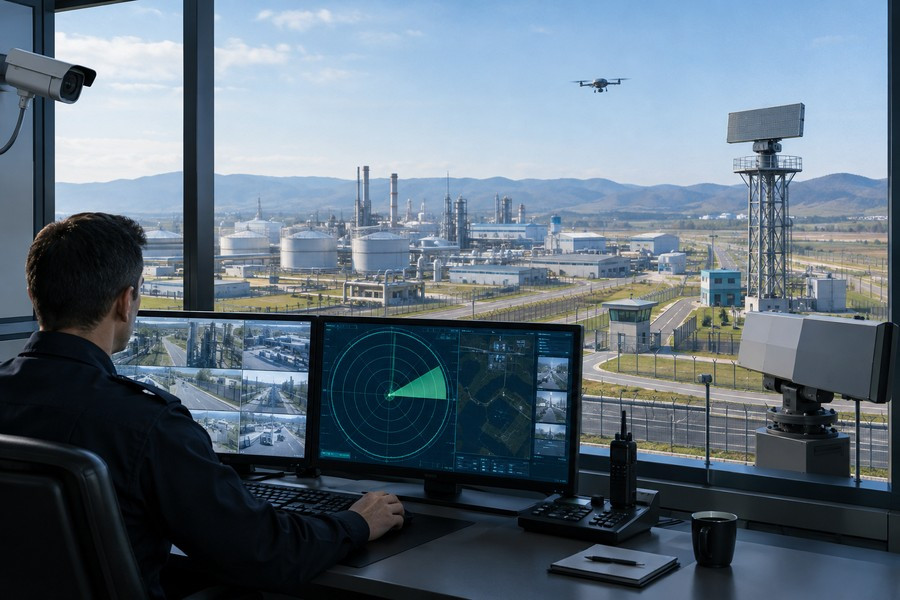
Israeli Security Company Broadens Drone Detection Technology
Technology Built for Large, Protected Areas
An Israeli technology company is expanding its work in drone detection as unmanned aircraft become cheaper, easier to use, and more common. The company has spent years building radar systems for commercial security. It is now applying that experience to military and defense needs.
The business was founded by Aviel Kisliansky and Amit Isseroff. Its first products focused on ground-based radar that could spot people or vehicles crossing a protected boundary. Although commercial security remains its main business, the same technology can also support military operations and other defense missions.
The company’s approach is based on a simple goal: security teams should be able to watch large areas without replacing all of their current equipment. Instead of depending only on video cameras, operators can use radar to find movement and track objects across a site.
The company serves customers in more than 70 countries. Its systems are used at airports, seaports, power stations, data centers, prisons, and other locations where security is a major concern.
Radar Works With Existing Security Systems
The radar equipment is designed to find and follow moving objects. It also uses artificial intelligence and machine learning to help identify what the radar is seeing. This can help security staff separate possible threats from normal activity and reduce false alarms.
The systems are built to work in different weather conditions. They can also connect with camera equipment that a customer already owns. This gives operators more choices and avoids forcing them to buy one complete system from a single supplier.
That flexibility matters to large commercial facilities. Many of these sites already have wide security networks in place. Adding radar can improve their ability to detect movement without requiring a costly, full-scale replacement of their current equipment.
The company also offers software that places radar alerts inside a wider security management system. This allows operators to view radar information along with other security data and respond from one central environment.
Different Radar Models Cover Different Ranges
The company has developed several radar models for sites with different coverage needs. Each system is designed to detect people, vehicles, or boats at a specific distance.
- One model can detect people, vehicles, and boats at distances of up to 150 meters.
- A second model extends detection to about 250 meters.
- A longer-range model can find people at up to 400 meters and vehicles or boats at up to 600 meters.
- The most powerful model can detect people at distances of up to 800 meters and vehicles or boats at up to one kilometer.
Depending on the model, the systems cover an area between 100 and 120 degrees from side to side. Their vertical coverage reaches about 30 degrees. Across the product line, location accuracy can reach 0.1 meter. The longer-range systems provide side-to-side accuracy of about 0.7 degrees.
Small Drones Create a New Security Challenge
The company is now using the same detection and tracking methods to address the growing threat from small unmanned aircraft. These drones can fly at low heights and approach protected locations in ways that traditional security systems may not handle well.
Many security systems were designed mainly to watch activity on the ground or to detect aircraft at much higher altitudes. A small drone flying close to the ground may be harder to identify, especially when buildings, trees, or other objects block a camera’s view.
For a commercial facility, the first step is knowing that a drone is nearby. Security teams then need to follow its path and decide whether it presents a danger. Having enough warning can give operators time to protect people, secure sensitive areas, or take other steps.
The company combines radar detection with cameras to provide a fuller view of the situation. Radar can help locate and track the drone, while cameras can help operators examine and identify the object.
This combined approach can be useful at facilities spread across large or difficult areas. Operators can adjust the system to match the size, layout, and risks of each location instead of relying on one fixed surveillance method.
Commercial Experience Supports Defense Work
The basic skills behind the system include detecting movement, following objects, and combining information from several sensors. Those abilities can be used in both civilian security and military settings.
The company has received a contract worth 21 million Israeli shekels to provide hundreds of radar systems to Israel’s Defense Ministry. The equipment was deployed near the Lebanese border to improve the detection and identification of fiber-optic drones used by Hezbollah.
Fiber-optic drones can be difficult to counter because they may not depend on common wireless links. Detecting their movement early is therefore an important part of protecting border areas and other sensitive locations.
As drones continue to spread, security operators are looking for systems that can detect them before they reach a protected site. Radar combined with cameras and existing security tools gives the Israeli company a way to extend its commercial technology into this growing area of defense.