
A New York Museum Turns Visitors Into Part of the Art
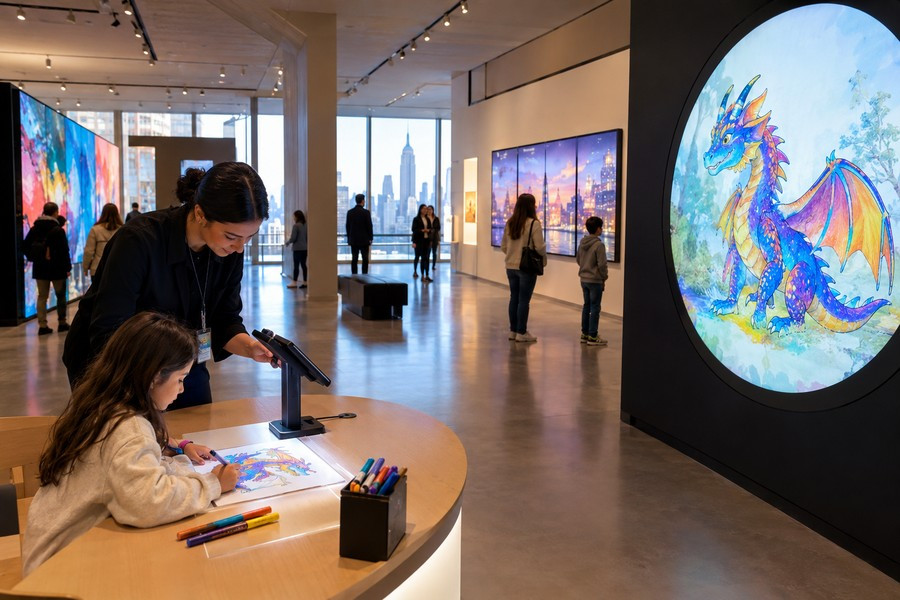
At a low table, visitors sit with crayons and a black-and-white drawing of a dragon. The creature wears a crown over its eyes. People can choose its colors, filling in the head, body, and scales however they like. Then the drawing leaves the table and appears inside a moving digital world.
This activity is part of an immersive art and technology museum in New York. The museum has 15 connected rooms, each offering a different way to see, hear, or interact with art. After a visitor finishes coloring, a staff member scans the picture. The dragon then appears on a round screen, where it dances and waves. Soon it vanishes, only to show up again on another screen elsewhere in the space.
Visitors do more than look at the artwork. They help bring it to life.
Famous Art Fills the First Room
The first room invites guests to imagine how great artists might use today’s technology. Laser projectors spread images of well-known artworks across the walls, ceiling, and floor. The displays shift and change around the room, turning familiar works into something visitors can walk through.
Marble statues inspired by ancient Greece appear with robotic arms. Digital waves move over the walls and seem to spill onto the floor. Flowers open, change color, and drift across large screens.
Visitors can choose different ways to take in the scene. A swing hangs from the ceiling, letting people gently turn and view the images from new angles. Couches placed around the room offer another option: guests can lie back and watch the artwork move above them.
Light That Moves With You
In the Infinite Room, rows of LED lights reflect in mirrors around the space. The reflections seem to stretch endlessly, forming a changing flow of color. Classical music plays as the lights shift in time with the sound.
Another room, called the Engine, surrounds visitors with gold, white, and blue light. The displays respond to movement. When someone waves an arm, flashes of color sweep across the walls and follow the action.
The rooms are linked by dark hallways that feel like backstage paths in a theater. Visitors may not always know what comes next, and that is part of the design. They are encouraged to explore and find their way through the museum.
A Chance to Explore at Your Own Pace
Private visits are available before or after the museum’s public hours. Groups can also reserve the entire space. The museum covers 36,000 square feet, so a private visit gives guests more room to move around, spend time in each room, and experience the installations without the usual crowds.
Whether visiting during regular hours or booking a private tour, the experience draws attention away from the busy neighborhood outside. One moment, guests are standing beneath a huge digital image. The next, they may be moving through shifting lights or watching a display react to their gestures.
There is no single way to experience the art. Guests can look closely, sit back, move around, or take part in the activities. The museum invites people to use their senses and to treat the space as a place to explore, not simply a row of artworks to view.
Play Is Part of the Experience
The colored dragon returns throughout the museum after it is scanned. It becomes one small part of the digital environment, moving among other images and installations. Visitors can also play with sand, swing, or step into a glowing ball pit.
These activities bring a playful feeling to a part of Manhattan known for its busy streets and fast pace. Adults and children alike get the chance to move, experiment, and act freely. For a little while, the city outside can fade from view.
The museum’s central idea is simple: art can be something people enter and affect, not just something they stand in front of. Through projected images, responsive lights, music, and hands-on activities, visitors become part of a changing world. They leave behind their own small mark, like a brightly colored dragon that keeps appearing across the museum.