
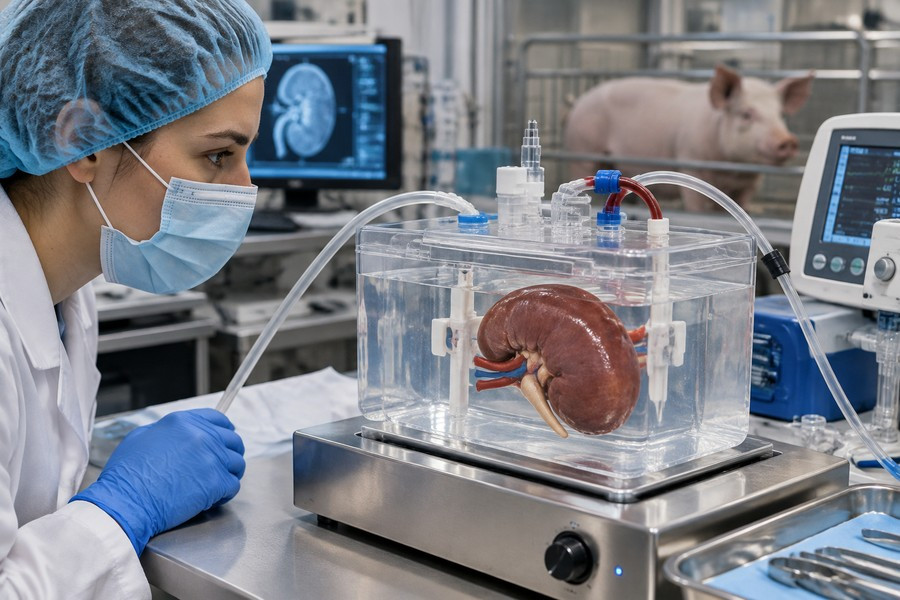
Frozen Pig Kidneys Work After More Than a Year in Storage
Donor organs often have only a short time to reach a patient. A heart or lung usually needs to be transplanted within six hours. Kidneys can last longer, but they generally must be used within about 36 hours. These limits make it difficult to get organs to the people who need them.
A research team in Minnesota has tested a method that could give kidneys a much longer storage life. The scientists froze pig kidneys for months, including one kidney kept in storage for more than a year. They then warmed the organs and transplanted them into pigs. The transplanted kidneys showed signs of working.
After the kidneys were warmed and placed in the recipient pigs, they regained their color and helped the animals make urine. These are important signs that blood was flowing through the organs and that they were carrying out a basic kidney function.
Keeping an Organ in a Glass-Like State
The method is called vitrification. First, the organ is treated with a chemical mixture that helps protect it from damage during freezing. The kidney is then cooled to about -238 degrees Fahrenheit, or -150 degrees Celsius. At that temperature, it can enter a glass-like state that keeps it preserved.
One of the researchers said that tissue may remain stable for a very long time once it reaches about -184 degrees Fahrenheit, or -120 degrees Celsius. The team believes this could allow organs to stay in storage for extended periods, instead of being limited to a few hours or days.
Vitrification is already used to preserve eggs, sperm, and embryos. But freezing a whole organ is much harder. Larger pieces of living tissue are more difficult to cool and warm evenly. Uneven temperature changes can harm cells and damage the organ.
Nanoparticles Help Warm the Kidneys
To address the warming challenge, the team worked with engineers to add tiny iron-oxide particles to the protective solution. These particles conduct heat and electricity. When activated, they help warm the kidney more evenly, reducing the risk that some areas will heat faster than others.
The researchers used the approach in earlier tests with rat kidneys and in a test involving a pig kidney stored for a shorter period. The latest work extends the storage time to many months and, in one case, beyond a year. The organs were thawed, examined, and transplanted into test animals.
The results are an early step, not proof that frozen organs are ready for use in people. The findings are still being reviewed by other scientists, and the work has focused on pig kidneys rather than human organs.
What It Could Mean for Transplants
The team’s larger goal is to adapt the process for human organs. If researchers can safely preserve organs for much longer, hospitals could have more time to match donors with recipients and move organs where they are needed. Longer storage might also reduce the pressure to perform transplant surgery within a very narrow window.
Preserving a kidney this way could be a major change in transplant care, but many difficult problems remain. Human organs are larger, and the method must work throughout the entire organ, not just in a small area. Researchers also need to control how the protective chemicals move through the tissue and make sure they do not harm living cells.
In their research, the team described several challenges that still need to be solved:
- Cooling: The whole organ must reach the right temperature without damaging its tissue.
- Protection chemicals: The chemical mixture must remain stable and spread through the organ.
- Safe warming: The kidney needs to warm evenly when it is taken out of storage.
- Biological safety: The protective chemicals must not cause harmful effects in the organ.
For now, the tests show that pig kidneys can survive very long periods of deep storage and still show signs of function after warming and transplantation. Turning that result into a dependable method for human organs will require more research. But the work points toward a future in which donated organs may no longer need to be used within only a few hours.