
How Much Further Can Computers Improve?
Computers have become far smaller and faster, but the rules behind their progress are not the same as the laws of nature. Past trends describe what engineers have managed to build so far. Physics sets much deeper limits on how much information a machine can process, store, and send.
Those limits may seem far away. Still, trying to approach them can have two benefits: it can lead to better technology and help scientists learn more about the physical world.
Early Steps Toward Smaller Machines
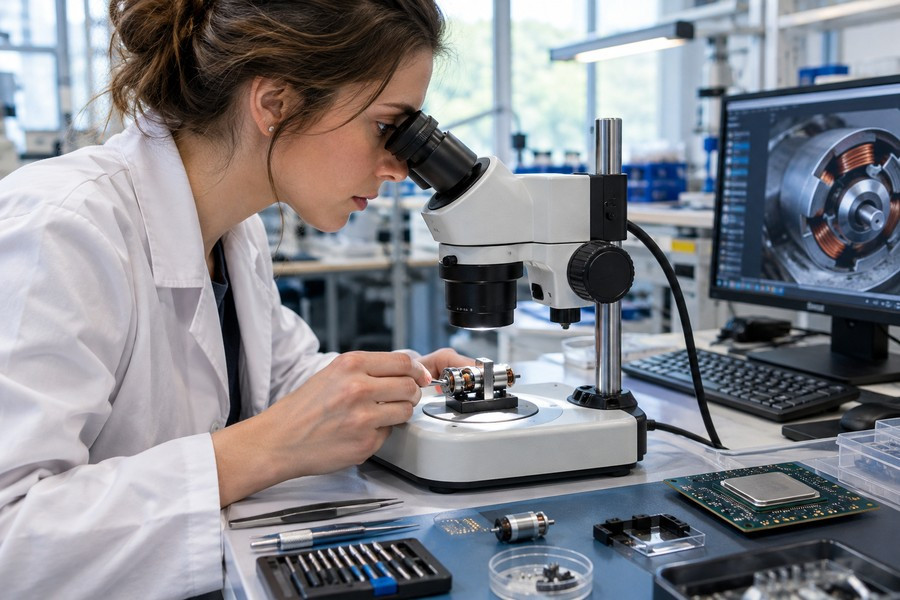
In a famous lecture, physicist Richard Feynman offered two cash prizes for feats of miniaturization. One prize was for building a working electric motor inside a cube smaller than 0.4 millimeters on each side. Engineer William McLellan met the challenge about a year later. His motor weighed about a quarter of a milligram and was roughly the size of a grain of sand. He assembled it by hand under a microscope, using tiny tools.
The second prize was harder. It called for shrinking a page of writing by a factor of 25,000 in both directions, making it small enough for a full encyclopedia to fit on a pinhead. That challenge remained unmet for 25 years. In 1985, graduate student Tom Newman used an electron-beam machine to copy the opening page of A Tale of Two Cities at the required size.
Meanwhile, engineers were finding new ways to build electronic circuits. In 1958, Jack Kilby connected a transistor, a capacitor, and three resistors made from one piece of germanium. His work showed that a whole circuit could be built from a single piece of semiconductor material.
The number of parts that could fit on a chip kept growing. In 1965, engineer Gordon Moore described the trend and projected that it would continue. His observation became known as Moore’s Law.
Why Chip Speed Changed
For decades, smaller transistors brought a bonus: they could switch faster while using less power. This pattern, called Dennard scaling, began to break down around 2004. Chips were producing too much heat when all their transistors ran at full speed. Clock speeds stopped rising, and a planned four-gigahertz processor was canceled.
Instead of making one chip core faster, companies began putting more cores on a chip. More recently, progress has relied heavily on connecting more chips, adding memory, and supplying more power and cooling. This is especially clear in artificial intelligence. The computing work used to train AI models has doubled about every six months since 2010, a pace far faster than the old chip-shrinking trend.
Chips still improve, but each new generation takes longer to arrive and often brings a smaller gain. That slowdown is not a fixed rule of physics. Today's computers remain far from the most that physical laws allow.
The Limits Set by Nature
Since the first transistor, the number of transistors that fit on a chip has increased by a factor of 10 billion. More than 100 million can now fit in a square millimeter. Computing speed has improved by a factor of a trillion, while the energy needed for one basic switching operation has fallen from about 100 joules to one femtojoule, or one-quadrillionth of a joule.
Communication has a physical limit, too. Information travels through wires and optical fibers in tiny packets of energy. For light, those packets are photons. Quantum mechanics limits how many different messages can be carried by a stream of photons. A one-watt light signal could, in theory, carry about 100 quadrillion bits each second. Today's optical connections deliver roughly one-millionth of that amount for the same power.
Four basic limits describe the deepest boundaries of computing:
- Quantum mechanics limits how quickly a computer can perform operations.
- General relativity places a cap on how much information can fit in a given space.
- Information theory limits how quickly information can be sent.
- Information theory also sets a minimum energy cost for an irreversible computing step.
Where the Biggest Gaps Remain
The largest gap is in computing speed. Today's machines are about 35 orders of magnitude below the physical limit. Closing that distance would require a radically different kind of computer, one able to use the energy contained in a mass of matter to perform calculations.
Quantum computers might move closer to that goal if they could turn the many properties of atoms into reliable computing parts. Current machines face the opposite problem: each quantum bit, or qubit, takes an enormous amount of material to create. Trillions of atoms may be involved in one qubit, and a single useful, dependable qubit can require dozens or even thousands of fragile ones working together.
The energy limit is closer. Today's chips use less than a million times more energy per operation than the theoretical minimum known as the Landauer limit. But ordinary computer switches need enough energy to avoid being flipped by heat alone. That requirement keeps them at least 100 to several thousand times above the minimum.
Memory could become much denser if storage devices used all three dimensions at the scale of molecules. DNA already stores information in a tiny space, and living things have used it as a storage system for billions of years. Feynman estimated that one bit might need a cube made of 125 atoms; DNA can store one in about 30. The main barriers are the expense and slow speed of writing DNA, not its storage density.
Communication may reach its limit sooner than the other areas. The gap between current systems and the theoretical limit is about a factor of one million. Data centers need to move more information while using less electricity, so engineers are developing connections that use light close to the chips themselves. Some quantum machines also send information using signals made of individual photons.
Building Up From Physics
It is reasonable to question the value of limits that seem impossibly distant. Some ideas, including reversible computing, quantum computers, and DNA storage, have been described as nearly ready for decades. A computer that uses all the energy in a piece of matter may never be practical.
But there is still useful work between today's machines and nature's limits. One boundary is a practical ceiling: how many devices can be made, how much electricity can be supplied, and how much land and cooling water can be used. The other is a physical floor: the least energy, time, or material needed to compute, store, or send information.
For much of computing's history, machines grew both more numerous and more capable. Now, simply building more is bringing power, land, and water limits into view. A different path is to begin with experiments that work close to the physical limits, then find ways to turn them into useful systems.
This approach has worked before. The transistor began as a physics experiment before it became an industry. Lasers moved from laboratory curiosities to carrying conversations across oceans. A discovery about magnetic materials later helped make computer disk drives practical. In each case, experiments showed what could be done before engineers found ways to build at scale.
The next major advances may come from building upward from the limits of physics, rather than only making today's machines larger or smaller. There is still considerable room for new ideas.