
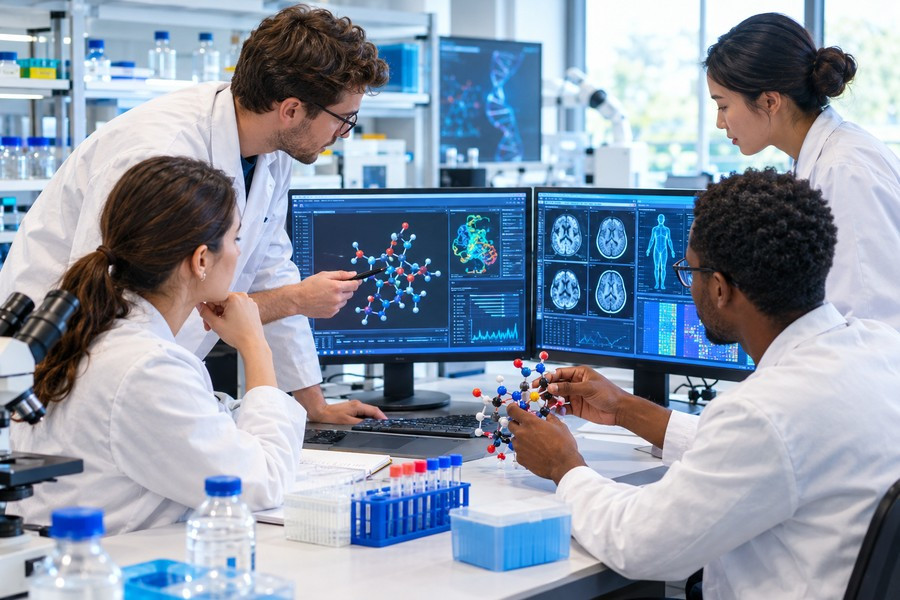
Research Teams Invited to Join Short-Term Life Sciences Projects
A new collaboration program is inviting life sciences researchers to propose projects that explore important questions in biology, chemistry, medicine, and clinical research. The opportunity is open to principal investigators and their research teams at universities, nonprofit organizations, and government laboratories.
Selected teams will work directly with researchers who develop advanced artificial intelligence tools. The goal is to use these tools to study difficult scientific problems and produce useful results within a focused 8- to 12-week project period.
Areas of Research
Proposals may focus on several parts of the life sciences. These areas include:
- Causal human biology
- Structural and computational molecular biology
- Medicinal chemistry
- Drug discovery
- Clinical science
Researchers may choose a question that fits their own work. Projects could involve early scientific findings, answers to unresolved questions, new datasets, research tools, or public resources that may help other scientists.
What Participants Will Do
During the collaboration, guest investigators will work closely with the research team to examine a problem of interest. Together, they will decide which analyses, digital tools, and other research materials would be most valuable.
The artificial intelligence models and supporting systems needed for the work will be provided at no cost to participating investigators. This allows research groups to test new methods without paying for access to those tools during the project.
At the end of the collaboration, the teams will work together to share their findings. Plans include publishing the project results and releasing related data and computer code as open-source materials when appropriate.
Researchers Keep Control of Their Data
Guest investigators will keep the rights to their own data throughout the entire project. They will also keep the rights to any separate research that grows from the collaboration later.
Applicants do not need to provide private or unpublished data as part of the application. They are asked to use only information that is already publicly available when describing their proposed project.
This approach allows research teams to explore a possible partnership while protecting ownership of their work and allowing them to decide how their data should be used.
What Makes a Strong Proposal
Applicants should clearly explain why working directly with the artificial intelligence research team would help their project. A strong proposal should connect the team’s scientific question with the tools, expertise, and support available through the collaboration.
Proposals should also explain what the research group expects to produce during the limited project period. The results do not need to solve an entire scientific problem, but the team should show that it can create useful early evidence or other meaningful progress within 8 to 12 weeks.
Possible project results may include:
- Early evidence related to a scientific question
- Preliminary discoveries that can guide future research
- Analyses that address an open problem
- Open-source datasets or software tools
- Public research materials for wider scientific use
Early Results Are the Main Goal
Many important questions in biology and medicine take years to confirm. The program recognizes that a short collaboration cannot fully validate most major discoveries.
Instead, the focus is on producing useful early results. These findings may help researchers decide which ideas deserve deeper testing, larger studies, or longer-term investigation.
Some projects may be considered for an extension after the first collaboration period. Any continued work would depend on the project’s progress and the value of extending the partnership.
Application and Selection Process
Applications will remain open for about two weeks. After the application period ends, organizers expect to contact selected participants by electronic message within roughly another two weeks.
The program may expand in the future as the organizers learn more about the types of support that scientific teams need. The current invitation is intended to test how close cooperation between life sciences researchers and artificial intelligence specialists can speed up early-stage research.
Researchers interested in participating should submit a proposal that describes the scientific question, the planned work, the expected results, and the specific value of the collaboration. The strongest applications will present a focused project that can make clear progress within the available time.