
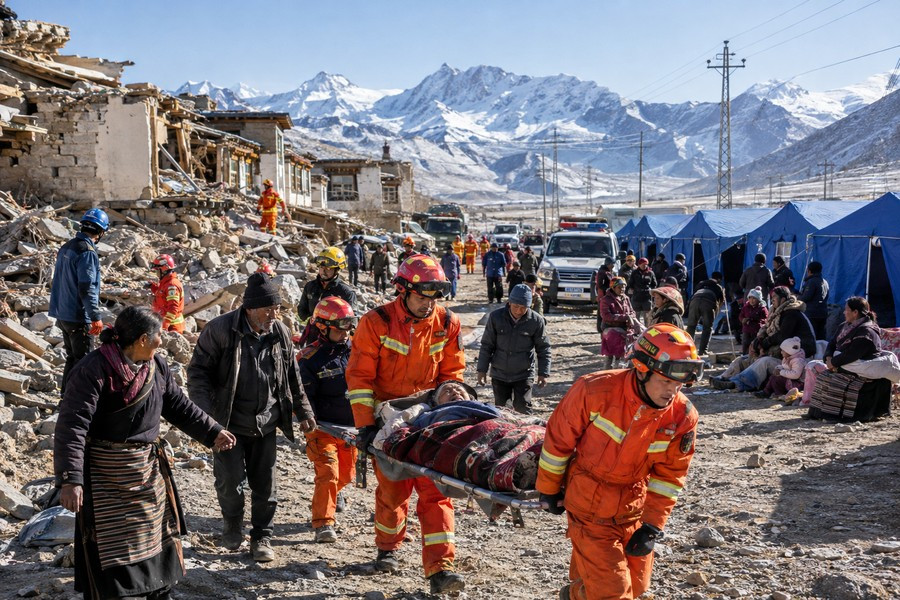
Deadly Earthquake Strikes High-Altitude Tibet Region
A powerful magnitude 7.0 earthquake struck a mountainous part of Tibet, killing at least 16 people and injuring dozens more. The quake hit Baqên County in the Nagqu region during the night, shaking homes and buildings across the area.
At least 65 people were injured, including 11 with serious injuries. Rescue workers, medical teams, firefighters, police officers, and other emergency crews were sent to the affected communities.
Homes Collapse and Power Is Cut
The earthquake caused widespread damage in the high-altitude region. Electricity was knocked out, and 339 homes collapsed. Power had returned to some areas by the following morning, but many residents remained without safe housing.
More than 12,400 people were moved to safer locations. Many spent the night in tents or inside vehicles because they feared that more shaking could trap them inside damaged buildings.
Rockfalls blocked roads in several places. The closures made it harder for rescue crews to reach remote communities, especially in areas located high on the Tibetan Plateau.
Rescue Efforts Face Severe Conditions
The earthquake zone sits about 4,800 meters above sea level. The thin air, freezing temperatures, rough terrain, and blocked roads have created serious challenges for rescue workers.
Emergency officials have ordered urgent search-and-rescue work, medical care for the injured, and temporary housing for people forced from their homes. A special emergency team was also sent to help direct relief operations.
The government has set aside 50 million yuan for disaster assistance in the region. The money is expected to support rescue work, medical treatment, shelter, food, and other basic needs.
Hundreds of Aftershocks Recorded
The main earthquake was followed by more than 400 aftershocks. Seven of the strongest tremors occurred close to the earthquake’s center. The largest measured 5.2 in magnitude and happened about 10 kilometers below the surface.
Shallow earthquakes can cause greater destruction because their energy reaches the ground more directly. Continued aftershocks have made residents afraid to return to homes that may already be weak or damaged.
People in the area described a sudden and violent shaking. One resident said she woke up as her home began to move. She ran outside barefoot, struggling to keep her balance while going down the stairs.
Another witness compared the noise and movement to hundreds of yaks charging past at once. In many communities, people rushed into the streets in darkness as buildings shook around them.
Remote Communities Remain at Risk
Baqên County is in the Nagqu region, about 400 kilometers northeast of Lhasa, the capital of Tibet. The area is part of China’s Tibet Autonomous Region and includes wide mountain ranges and isolated settlements.
The difficult landscape can slow the delivery of food, medicine, blankets, and other supplies. Rescue crews must travel across narrow roads that can be blocked by falling rocks or damaged by ground movement.
Emergency teams in the region have experience working in harsh mountain conditions. Soldiers, firefighters, police officers, and specialist rescue workers have previously reached earthquake zones within hours of major disasters.
A Region Known for Strong Earthquakes
Tibet and nearby parts of western China sit in an area with frequent seismic activity. A magnitude 6.2 earthquake in nearby Gansu province killed more than 120 people during an earlier disaster.
The wider region has also faced other deadly emergencies. Severe floods and landslides caused by a glacier collapse killed at least 1,400 people across Tibet and Nepal. Hundreds of others remained missing after that disaster.
With more aftershocks possible, authorities have urged people to stay away from damaged buildings and remain in safer outdoor areas or emergency shelters. Rescue workers continue searching for survivors, treating the injured, and helping families whose homes were destroyed.