
U.S. Officials Order Non-Essential Staff to Leave Saudi Arabia After Security Threats
Rising Threats Across the Kingdom
Non-essential U.S. government employees and their family members have been told to leave Saudi Arabia because of growing safety concerns. The warning follows attacks linked to Iranian-supported Houthi forces, including strikes on civilian airports and other important facilities.
These attacks have caused civilian deaths, serious travel problems, and damage to key infrastructure. The conflict could spread quickly beyond the areas already affected. People in Saudi Arabia should remain alert and prepare for sudden changes in travel or security conditions.
Airport Service Remains Limited
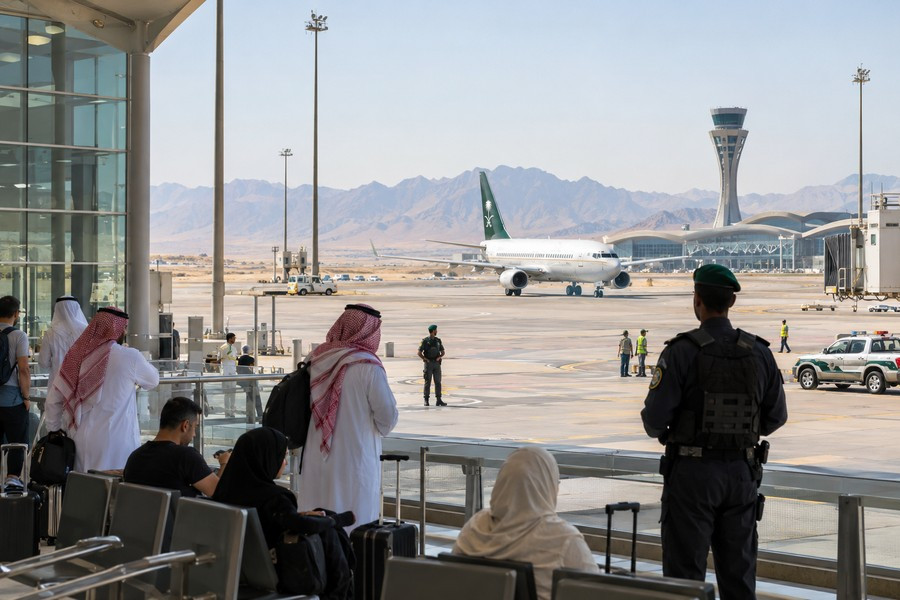
Several airports in Saudi Arabia are still operating, but travelers may face delays, canceled flights, or sudden closures. Recent missile and drone attacks have increased the risk to airports and airspace.
The main airport in Riyadh has reopened in part. Domestic flights and some international flights operated by Saudi carriers are running. A small number of flights normally based in Riyadh have moved to the airport near Qassim.
The main airports serving Jeddah and Dammam are also open. However, both locations may have delays and canceled flights. Travelers should check directly with their airline and the airport before leaving for a flight.
People should not assume that a scheduled flight will operate as planned. Airspace restrictions, security alerts, or new attacks could change airport operations with little notice.
Other Ways to Travel
Travelers who cannot fly may be able to use trains, buses, or private cars. Availability, routes, and schedules can change, so passengers should confirm all details directly with the transportation provider.
- Rail service may provide an alternative between major cities.
- Long-distance bus service continues to connect several areas.
- Private vehicles may be used when roads and border crossings are open.
All land border crossings remain open, including the causeway connecting Saudi Arabia with Bahrain. Major roads and highways around Riyadh, Jeddah, and Dhahran also remain open.
Airports in nearby Bahrain, Jordan, Oman, Qatar, and the United Arab Emirates are operating. Travelers using those airports should confirm their status before making plans, since regional conditions can change quickly.
Rules About Photos and Videos
Saudi authorities continue to warn that filming, posting, or sharing images of missile and drone defenses or strike locations can lead to legal trouble. This rule also applies to photos of government buildings, airports, and damaged sites.
U.S. citizens have been detained for breaking these rules. Visitors and residents must follow Saudi laws while inside the country, including restrictions on photography and online posts.
Residents should also pay attention to emergency alerts sent to mobile phones by Saudi civil defense authorities. These messages may contain instructions during an attack or other emergency.
Restrictions on U.S. Government Employees
U.S. government employees in Saudi Arabia need special approval from the chief U.S. mission officer before using any airport in the country.
They are also barred from traveling within 20 miles of the Yemen border because of security risks. Special approval is required for travel to the provinces of Jizan, Asir, and Najran, as well as the cities of Qatif, Yanbu, and Taif.
Emergency help for U.S. citizens remains available through consular services.
Steps Travelers Should Take
- Review the latest travel warnings for Saudi Arabia and Yemen.
- Register with the U.S. traveler alert program to receive security updates and make it easier for a U.S. mission to reach you.
- Keep your phone charged and store emergency numbers in your contacts.
- Stay away from windows, glass doors, and fallen debris during an aerial attack.
- Follow instructions from local authorities.
- Avoid protests, large crowds, and areas with a heavy police presence.
- Keep a low profile and stay alert in places linked publicly with the United States.
- Contact the airline directly about rebooking or canceled flights.
People should avoid areas affected by attacks and should not approach impact sites. They should also avoid taking pictures of damage, security forces, airports, or government buildings.
Emergency Numbers and Medical Care
For emergencies involving police, firefighters, or other services, call 911. The police number is 999, ambulance services can be reached at 997, and highway security can be reached at 996.
English-language medical care is available in major Saudi cities through large private hospital systems. Additional medical facilities are available in Riyadh and Jeddah. Travelers should identify the nearest hospital before an emergency occurs and keep important medical information close at hand.
U.S. citizens needing help can contact the U.S. mission in Riyadh at (966) (11) 835-4000, the consular office in Jeddah at (966) (12) 220-5000, or the consular office in Dhahran at (966) (13) 839-5700. Consular assistance from abroad is available at 202-501-4444. People calling from the United States or Canada can use 1-888-407-4747.